Health and fitness calculators are presented as practical tools for understanding body composition, calorie needs, exercise output, and health risks. The guide explains how common calculators work, why accurate inputs matter, and how to choose tools that match specific goals such as weight loss, muscle gain, or cardiovascular improvement.
It also shows how to combine results from multiple calculators to set realistic goals, track progress, and know when to seek professional medical advice. The overall message is that these calculators are starting points for better decisions, not final answers.
Health & Fitness Calculators: Complete Guide for Better Wellness
If you’ve ever typed your stats into a BMI calculator and had no idea what to do with the number afterward, you’re not alone. Health and fitness calculators are genuinely useful tools — but only when you know which ones to trust and how to actually apply the results.
This guide is for everyday people who want straight answers about their health. No personal trainer required, no nutrition degree needed. Just you, your numbers, and a clear plan for what to do next.
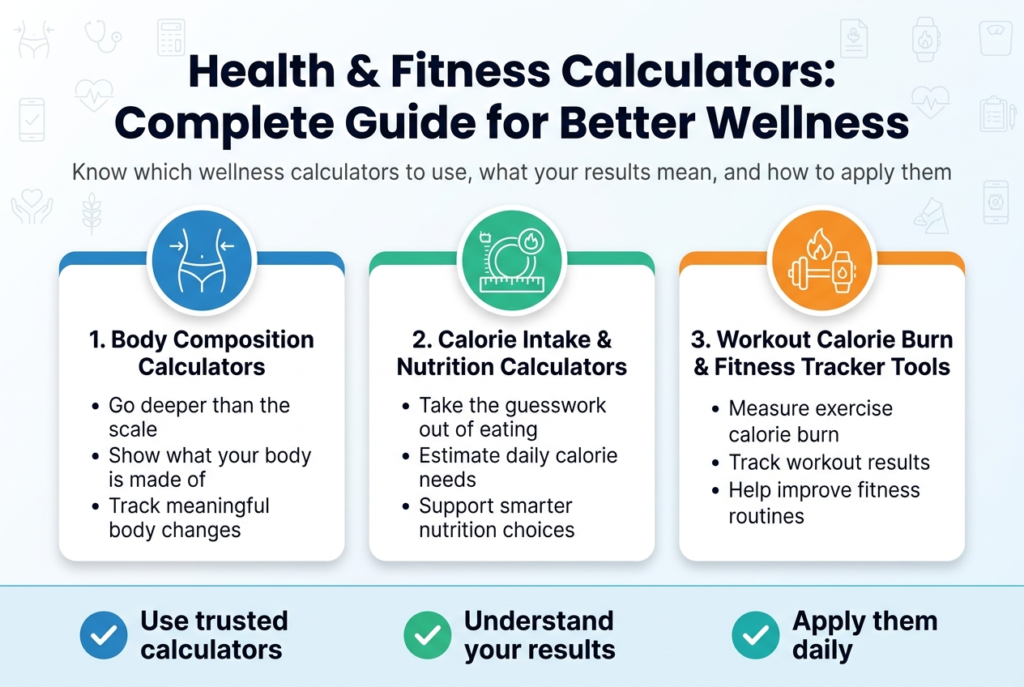
Here’s what we’ll walk through together:
- Body composition calculators that go deeper than the scale and show you what your body is actually made of
- Calorie intake and nutrition calculators that take the guesswork out of eating
- Workout calorie burn and fitness tracker tools that help you get real results from your exercise routine
By the end, you’ll know exactly which wellness calculators to use, what your results mean, and how to plug them into your daily routine in a way that actually sticks.
Understanding Health and Fitness Calculators
What Health and Fitness Calculators Are and How They Work
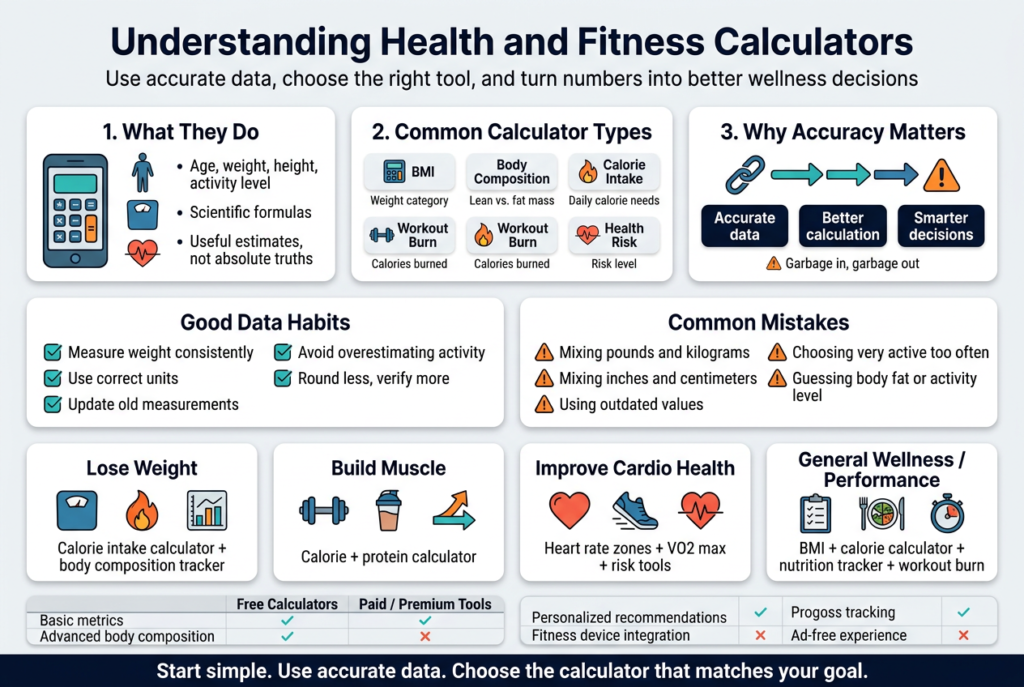
Health and fitness calculators are digital tools designed to take raw numbers about your body and lifestyle and turn them into something actually useful. You plug in data like your age, weight, height, or activity level, and the calculator runs it through a scientific formula to spit out a result that helps you make smarter decisions about your health.
At their core, these tools rely on established equations developed through decades of clinical research. A BMI calculator, for example, divides your weight in kilograms by the square of your height in meters, giving you a standardized number that broadly categorizes your body weight status. A calorie intake calculator might use the Mifflin-St Jeor equation to estimate your basal metabolic rate — the number of calories your body burns just keeping you alive — and then factor in your daily movement to give you a personalized calorie target.
Here’s a quick look at how different types of health and fitness calculators work under the hood:
| Calculator Type | Core Input Data | Formula/Method Used | What It Tells You |
|---|---|---|---|
| BMI Calculator | Height, weight | Quetelet Index (kg/m²) | Weight category (underweight to obese) |
| Body Composition Calculator | Weight, body fat % | Various (skinfold, DEXA-based) | Lean mass vs. fat mass ratio |
| Calorie Intake Calculator | Age, sex, weight, height, activity | Mifflin-St Jeor or Harris-Benedict | Daily calorie needs for maintenance, loss, or gain |
| Workout Calorie Burn Calculator | Weight, exercise type, duration | MET (Metabolic Equivalent of Task) | Calories burned during specific activities |
| Health Risk Assessment Tools | Blood pressure, cholesterol, lifestyle data | Clinical risk scoring models | Risk level for conditions like heart disease or diabetes |
The beauty of these tools is that they make clinical-level calculations accessible to anyone with a smartphone or laptop. You don’t need a dietitian in the room to get a ballpark figure on your daily protein needs or understand what your resting heart rate means relative to your fitness level.
That said, it’s worth understanding that most calculators produce estimates, not absolute truths. They’re working with population-level averages, which means individual variation — things like genetics, hormonal factors, or gut microbiome differences — won’t always be captured perfectly. Think of them as highly informed starting points rather than final answers.
Why Accurate Data Leads to Better Wellness Decisions
The old saying “garbage in, garbage out” is never more true than when you’re working with health and fitness calculators. The quality of the result you get is directly tied to the accuracy of what you enter. If you guess your weight, round off your height, or underestimate how sedentary your desk job makes you, your output will be off — and that can quietly push you in the wrong direction for weeks or months.
The Ripple Effect of Good Data
Accurate data creates a chain reaction of better decisions. Here’s what that looks like in practice:
- Calorie targets: If you accurately track your weight and correctly classify your activity level as “sedentary” rather than “moderately active” (a very common mistake), your calorie intake calculator will give you a more realistic number — one that actually moves the needle on weight loss instead of stalling it.
- Body composition tracking: Knowing your actual body fat percentage rather than just your scale weight tells you whether you’re losing fat, muscle, or a mix of both. That distinction changes everything about how you should eat and train.
- Fitness progression: Accurate data from a workout calorie burn calculator helps you understand your real energy expenditure so you avoid the trap of “out-eating your workout.”
- Health risk assessment: Entering real numbers into health risk assessment tools — your actual blood pressure reading, your true smoking history, your honest family medical history — gives you a risk profile that can genuinely motivate behavior change or flag a need for a doctor’s visit.
Common Data Entry Mistakes to Avoid
Most people don’t intentionally enter bad data — they just make small errors that add up. Watch out for these:
- Overestimating activity level: Picking “very active” when you work out three times a week but sit for most of the day inflates your calorie estimate significantly.
- Using old measurements: Your weight and body composition change. Update your numbers regularly — at minimum monthly if you’re actively working toward a goal.
- Ignoring unit differences: Mixing up pounds and kilograms or centimeters and inches is more common than you’d think, and it throws off every calculation downstream.
- Rounding too aggressively: A difference of 10 pounds or 2 inches in height might seem minor, but it can shift your BMI category or calorie target in a meaningful way.
The bottom line is simple: take five extra minutes to measure accurately before entering your data. Weigh yourself under consistent conditions (same time of day, similar clothing), use a proper measuring tape for height and circumference measurements, and double-check your units. That small upfront investment pays dividends in every recommendation the calculator makes.
How to Choose the Right Calculator for Your Goals
Not all wellness calculators are created equal, and grabbing the first one that pops up in a search result isn’t always the smartest move. With so many fitness tracker tools and nutrition calculators online competing for your attention, knowing how to filter for quality and relevance saves you a lot of time and confusion.
Match the Calculator to Your Specific Goal
Start with clarity on what you actually want to know. Here’s a practical breakdown:
- Losing weight: Start with a calorie intake calculator to establish your deficit target, then pair it with a body composition calculator to track fat loss versus muscle loss over time.
- Building muscle: A calorie and protein calculator is your first priority — you need to know your maintenance calories and then how much of a surplus to add.
- Improving cardiovascular health: Heart rate zone calculators and VO2 max estimators can help you train smarter, and health risk assessment tools can show you whether your current lifestyle is moving your markers in the right direction.
- General wellness monitoring: A BMI calculator and a basic calorie intake calculator are solid starting points, but don’t stop there — add a nutrition calculator to make sure your macros are balanced.
- Athletic performance: Look for workout calorie burn calculators that account for exercise type and intensity, along with recovery and training load tools.
Key Features of a Trustworthy Health Calculator
When you’re evaluating a wellness calculator, run it through this quick checklist:
- Scientific backing: Does the tool cite the formula it uses? Reputable calculators reference validated equations like Mifflin-St Jeor, the Katch-McArdle formula, or Framingham risk scores.
- Regular updates: Health science evolves. A calculator last updated in 2010 may not reflect current nutritional guidelines or clinical research.
- Personalization options: The more variables you can input (age, sex, fitness level, health conditions), the more tailored the result will be.
- Transparency about limitations: Good tools tell you what they can and can’t measure. Any calculator claiming to give you a perfect, definitive answer without any caveats should make you a little skeptical.
- Clear output with context: A number on its own isn’t enough. The best health and fitness calculators explain what your result means and suggest concrete next steps.
Free vs. Paid Calculator Tools
| Feature | Free Calculators | Paid/Premium Tools |
|---|---|---|
| Basic metrics (BMI, calories) | ✅ Available | ✅ Available |
| Advanced body composition analysis | Limited | ✅ More detailed |
| Progress tracking over time | Rarely included | ✅ Often included |
| Personalized recommendations | Generic | More tailored |
| Integration with fitness devices | Rarely | ✅ Common |
| Ad-free experience | ❌ Usually ad-supported | ✅ Typically ad-free |
For most people starting out, free wellness calculators are completely adequate. Sites from established health organizations, university medical centers, and certified nutrition platforms tend to offer reliable free tools with solid formulas behind them. If you’re serious about long-term tracking or want deeper integration with wearable fitness devices, upgrading to a premium app or platform can make the experience smoother and the data more actionable.
The key is to pick a calculator that matches both your current goal and your comfort level with data. Start simple, use it consistently, and graduate to more sophisticated tools as your understanding of your own body deepens.
Body Composition Calculators That Reveal Your True Health
BMI Calculator and Its Role in Assessing Weight Status
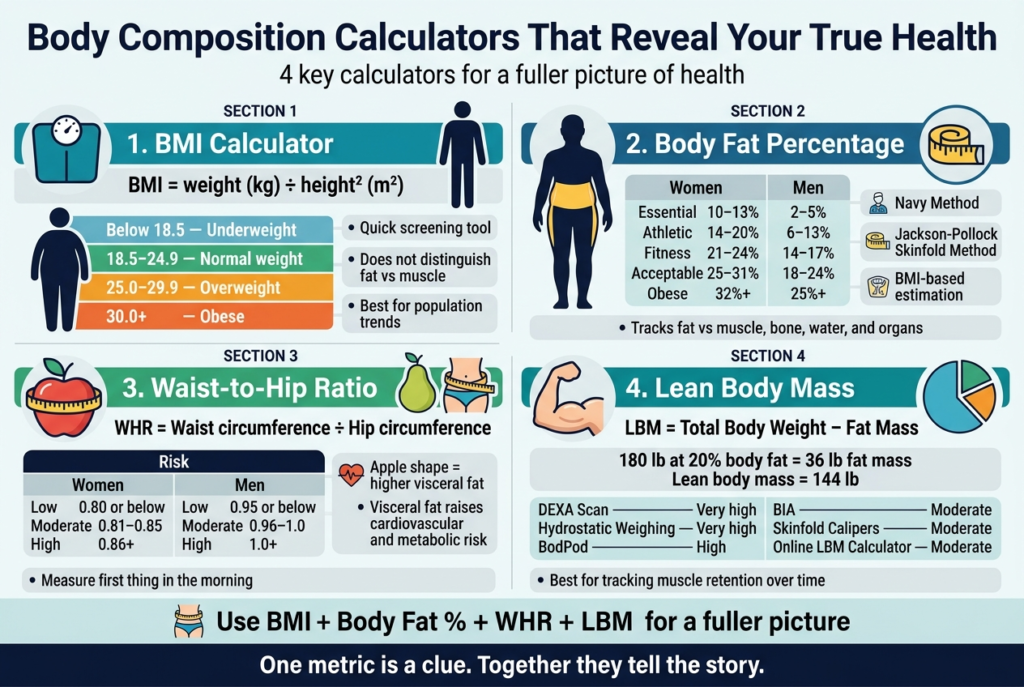
The BMI calculator is probably the most well-known tool in the world of health and fitness calculators, and for good reason — it gives you a quick snapshot of where your weight stands relative to your height. The formula is straightforward: divide your weight in kilograms by the square of your height in meters (kg/m²), and you get a number that slots into one of four categories.
| BMI Range | Category |
|---|---|
| Below 18.5 | Underweight |
| 18.5 – 24.9 | Normal weight |
| 25.0 – 29.9 | Overweight |
| 30.0 and above | Obese |
Here’s the thing though — BMI is a screening tool, not a diagnosis. A professional bodybuilder with dense muscle mass might land in the “obese” category despite having less than 10% body fat. On the flip side, someone with a “normal” BMI can still carry dangerous levels of visceral fat around their organs.
Where BMI Works Well
- Population-level health tracking — public health researchers love it because it’s cheap, fast, and requires zero special equipment
- Flagging potential risks — it’s a solid starting point that signals whether a more detailed assessment might be worth pursuing
- Monitoring weight trends over time — even if the absolute number isn’t perfect, watching your BMI shift over months tells a meaningful story
Where BMI Falls Short
- It doesn’t distinguish between fat mass and muscle mass
- It ignores fat distribution (where fat sits matters enormously)
- It can be less accurate for older adults, athletes, pregnant women, and certain ethnic groups (research shows South Asian and East Asian populations face higher health risks at lower BMI thresholds)
Use the BMI calculator as your opening move — a starting line, not a finish line. Pair it with other body composition calculators to get the fuller picture.
Body Fat Percentage Calculator for Measuring Real Fitness
If BMI is the wide-angle lens, body fat percentage is the zoom lens. This number tells you exactly how much of your total body weight is fat versus everything else — muscle, bone, water, and organs. That ratio is where real fitness lives.
What Are Healthy Body Fat Ranges?
| Category | Women | Men |
|---|---|---|
| Essential fat | 10–13% | 2–5% |
| Athletic | 14–20% | 6–13% |
| Fitness | 21–24% | 14–17% |
| Acceptable | 25–31% | 18–24% |
| Obese | 32%+ | 25%+ |
How Body Fat Percentage Calculators Work
Online body fat calculators typically rely on one of a few methods:
- Navy Method — uses measurements of your neck, waist, and hips (for women, the hip measurement is added) alongside height. It’s surprisingly accurate for most people and easy to do at home with a soft measuring tape.
- Jackson-Pollock Skinfold Method — requires caliper measurements at specific sites on the body. More precise but harder to self-administer.
- BMI-based estimation — some calculators derive an estimated body fat percentage from your BMI, age, and sex. Convenient, but less accurate than direct measurements.
Why This Number Matters More Than Scale Weight
Two people can weigh exactly the same and look completely different. A 170-pound woman with 18% body fat has a dramatically different body composition — and health profile — than a 170-pound woman with 35% body fat. The scale can’t tell that story. Body fat percentage can.
Tracking this number over time is especially powerful when you’re:
- Following a strength training program (muscle gain can mask fat loss on the scale)
- Coming off a period of inactivity and rebuilding fitness
- Monitoring progress during a body recomposition phase (losing fat while gaining muscle simultaneously)
Aim to recheck your body fat percentage every 4–6 weeks for meaningful trend data. Day-to-day fluctuations in hydration can skew readings, so always measure under consistent conditions — same time of day, same hydration status.
Waist-to-Hip Ratio Calculator for Identifying Health Risks
Your waist-to-hip ratio (WHR) might be the most underrated measurement in personal health. While people obsess over scale weight and BMI, this simple ratio quietly does some of the heaviest lifting when it comes to predicting cardiovascular disease, type 2 diabetes, and metabolic syndrome.
The calculation is dead simple:
WHR = Waist circumference ÷ Hip circumference
Measure your waist at its narrowest point (usually just above the belly button) and your hips at their widest point. Both measurements in the same unit — centimeters or inches, your choice.
What Do the Numbers Mean?
| Health Risk Level | Women (WHR) | Men (WHR) |
|---|---|---|
| Low risk | 0.80 or below | 0.95 or below |
| Moderate risk | 0.81 – 0.85 | 0.96 – 1.0 |
| High risk | 0.86 or above | 1.0 or above |
The World Health Organization flags a WHR above 0.85 for women and 0.90 for men as a significant health concern.
Why Fat Distribution Matters So Much
There are two main types of fat storage patterns — “apple” (fat stored centrally around the abdomen) and “pear” (fat stored around the hips, buttocks, and thighs). The apple pattern is the one that carries serious health baggage because it correlates closely with visceral fat — the deep abdominal fat that wraps around your liver, pancreas, and intestines.
Visceral fat is metabolically active in a bad way. It releases inflammatory compounds and hormones that disrupt insulin sensitivity, raise blood pressure, and spike cardiovascular risk. You can’t see visceral fat from the outside, but a high WHR is one of its strongest external signals.
Practical Tips for Measuring Accurately
- Stand relaxed — don’t suck in your stomach
- Use a flexible measuring tape held snug but not tight
- Measure twice and take the average
- Always measure first thing in the morning before eating
This tool works brilliantly alongside a BMI calculator and a body fat percentage calculator to paint a much more honest picture of your health than any single metric alone.
Lean Body Mass Calculator for Tracking Muscle Retention
Lean body mass (LBM) is everything your body is made of except fat — muscle, bone, water, organs, and connective tissue. Tracking it over time is one of the smartest things you can do, especially if you’re managing your weight through diet, building muscle through training, or recovering from illness or injury.
The basic formula:
LBM = Total Body Weight – Fat Mass
So if you weigh 180 pounds and have 20% body fat, your fat mass is 36 pounds, which makes your lean body mass 144 pounds.
Why Lean Body Mass Deserves More Attention
Most people focus entirely on the number on the scale. But scale weight alone doesn’t tell you whether you’re losing fat, losing muscle, or some combination of both. That matters enormously because:
- Muscle is metabolically active — the more lean mass you carry, the higher your resting metabolic rate. Losing muscle while dieting tanks your metabolism and makes future fat loss harder.
- Muscle affects functional health — strength, balance, mobility, and even insulin sensitivity are all tied to lean mass
- It’s a better predictor of long-term outcomes — studies consistently show that higher lean mass is associated with better survival rates and quality of life in older adults
Who Should Be Tracking Lean Body Mass Regularly?
- Anyone in a calorie deficit trying to preserve muscle (you want fat loss, not muscle loss)
- Athletes and gym-goers in a muscle-building phase who want to confirm their program is working
- Older adults monitoring for sarcopenia (age-related muscle loss, which typically accelerates after 50)
- People recovering from surgery, illness, or long periods of immobility
How to Track It Accurately
| Method | Accuracy | Accessibility |
|---|---|---|
| DEXA Scan | Very high | Low (requires clinic visit) |
| Hydrostatic Weighing | Very high | Low (specialized equipment) |
| BodPod | High | Moderate (some gyms/clinics) |
| Bioelectrical Impedance (BIA) | Moderate | High (home scales available) |
| Skinfold Calipers | Moderate | High (inexpensive tools) |
| Online LBM Calculator (Navy method) | Moderate | Very high (free, instant) |
For everyday tracking purposes, an online lean body mass calculator combined with consistent measurements using the Navy method is a solid, cost-free approach. Run your numbers every 4–6 weeks and look for trends rather than obsessing over any single data point.
The real magic of lean body mass tracking shows up over months, not days. If you’re dieting and your LBM stays stable while your total weight drops, you’re doing it right — you’re losing fat while keeping your metabolic engine intact.
Calorie and Nutrition Calculators for Smarter Eating
TDEE Calculator for Understanding Your Daily Energy Needs
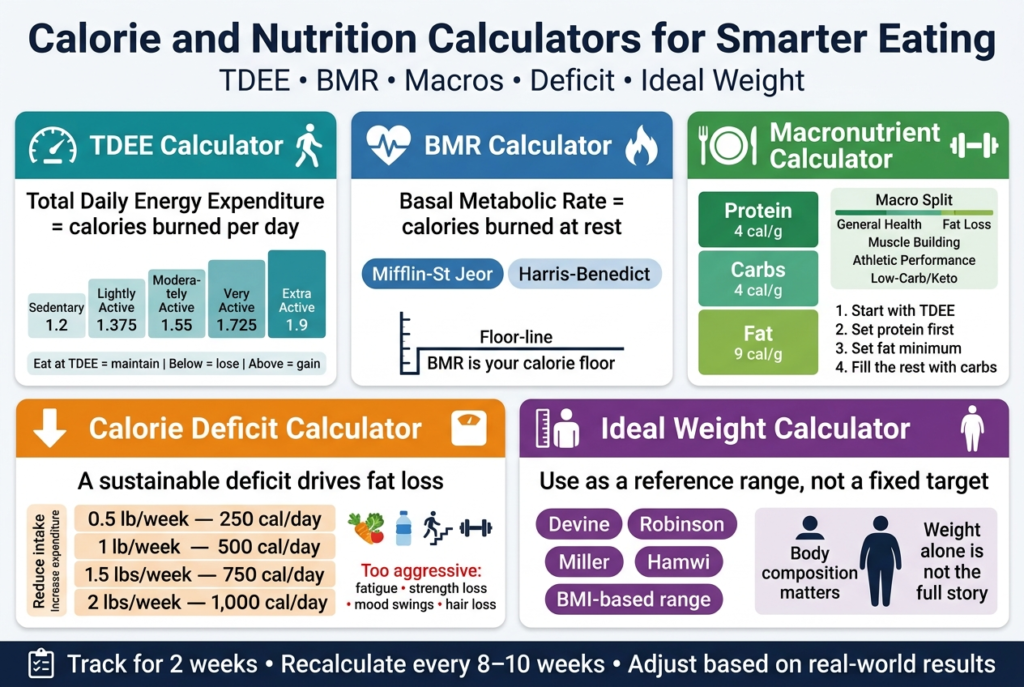
Your Total Daily Energy Expenditure (TDEE) is the total number of calories your body burns in a single day — and it’s probably one of the most important numbers you’ll ever calculate for your health journey. Unlike a rough estimate, your TDEE accounts for everything: your resting metabolism, the energy you burn walking to your car, your workouts, even the calories your body uses to digest food.
A TDEE calculator takes several inputs to give you a personalized number:
- Age — your metabolism naturally shifts as you get older
- Height and weight — used to estimate your body size and mass
- Biological sex — men and women have different metabolic rates on average
- Activity level — this is where most people either get it right or completely miss the mark
Activity Level Multipliers Explained
Most nutrition calculators use something called the Harris-Benedict or Mifflin-St Jeor formula and then multiply your BMR by an activity factor. Here’s how those levels typically break down:
| Activity Level | Description | Multiplier |
|---|---|---|
| Sedentary | Little to no exercise, desk job | 1.2 |
| Lightly Active | Light exercise 1–3 days/week | 1.375 |
| Moderately Active | Moderate exercise 3–5 days/week | 1.55 |
| Very Active | Hard exercise 6–7 days/week | 1.725 |
| Extra Active | Physical job + hard daily training | 1.9 |
One thing worth knowing: most people underestimate how sedentary they actually are. If you sit at a desk for eight hours and hit the gym three times a week for 45 minutes, you’re probably in the “lightly active” category — not “moderately active” like many people assume.
Once you have your TDEE, you have a rock-solid starting point. Eat at your TDEE, and your weight stays stable. Eat below it, and you lose weight. Eat above it, and you gain. It really is that straightforward at the foundational level.
How to Use Your TDEE Practically
- Track your calories for two weeks using a nutrition calculator online or an app, then compare your actual intake to your TDEE
- Recalculate every 8–10 weeks — as your weight changes, so does your TDEE
- Adjust based on real-world results, not just calculator outputs — if you’re eating at your calculated TDEE but still losing weight, your actual TDEE is higher
BMR Calculator for Finding Your Baseline Calorie Burn
Your Basal Metabolic Rate (BMR) is the number of calories your body burns just to stay alive — heart beating, lungs breathing, organs functioning — if you were lying still in bed all day. It’s your biological floor for calorie needs.
Think of BMR as the engine idling. You haven’t driven anywhere, but the car is still using fuel.
How BMR Is Calculated
Two formulas dominate the field:
Mifflin-St Jeor Equation (considered more accurate for most people):
- Men: (10 × weight in kg) + (6.25 × height in cm) − (5 × age) + 5
- Women: (10 × weight in kg) + (6.25 × height in cm) − (5 × age) − 161
Harris-Benedict Equation (older, still widely used):
- Men: 88.36 + (13.4 × weight in kg) + (4.8 × height in cm) − (5.7 × age)
- Women: 447.6 + (9.2 × weight in kg) + (3.1 × height in cm) − (4.3 × age)
Research generally gives the edge to Mifflin-St Jeor for accuracy across a wider range of body types, but both formulas are solid starting points when you plug your numbers into a health and fitness calculator.
What Your BMR Tells You
Your BMR is not the number you eat at — that’s a common mistake. It’s simply the baseline that gets multiplied by your activity level to produce your TDEE. Eating at your BMR would essentially be starving your body, since you burn more than that just getting through a normal day.
That said, knowing your BMR is genuinely useful for:
- Understanding how much of your calorie burn is passive — for most people, BMR accounts for 60–75% of total daily calorie expenditure
- Recognizing why crash diets backfire — eating too far below BMR can slow your metabolism over time
- Setting a hard floor for your calorie intake during weight loss phases
Factors That Influence BMR
- Muscle mass — muscle tissue burns more calories at rest than fat tissue does, which is why strength training matters beyond just aesthetics
- Age — BMR tends to decrease by roughly 1–2% per decade after age 20
- Thyroid function — an underactive thyroid can significantly lower BMR
- Body size — larger bodies generally have higher BMRs
Macronutrient Calculator for Optimizing Protein, Carbs, and Fat
Calories get you to the right energy balance, but macronutrients — protein, carbohydrates, and fat — determine the quality of that balance. A macronutrient calculator takes your calorie target and breaks it into specific gram targets for each of the three major nutrients.
This is where a basic calorie intake calculator evolves into something far more powerful for your health goals.
Why Macros Matter More Than Just Calories
Two people can eat the exact same number of calories and have completely different results — different energy levels, different body composition changes, different hunger levels throughout the day. The difference usually comes down to how those calories are distributed across macronutrients.
- Protein (4 calories per gram): Essential for muscle repair and growth, keeps you full longer, has the highest thermic effect of food (your body burns more calories digesting it)
- Carbohydrates (4 calories per gram): Primary fuel source for high-intensity activity, feeds your brain, regulates mood and energy
- Fat (9 calories per gram): Supports hormone production, aids in nutrient absorption, keeps joints healthy, essential for brain function
Common Macro Split Approaches
| Goal | Protein | Carbohydrates | Fat |
|---|---|---|---|
| General Health | 20–25% | 45–55% | 25–35% |
| Fat Loss | 30–40% | 30–40% | 25–35% |
| Muscle Building | 25–35% | 40–50% | 20–30% |
| Athletic Performance | 20–30% | 50–60% | 20–30% |
| Low-Carb/Keto | 25–35% | 5–10% | 55–70% |
These ranges aren’t rigid rules — they’re starting points you adjust based on how your body responds.
How to Use a Macronutrient Calculator Step by Step
- Start with your TDEE or calorie target (weight loss, maintenance, or gain)
- Set your protein target first — a common guideline is 0.7–1g per pound of bodyweight, or higher (up to 1.2g/lb) if you’re actively strength training
- Set your fat minimum — aim for at least 0.35g per pound of bodyweight to support hormone health
- Fill the rest with carbohydrates — they’re flexible and can be adjusted based on activity levels and personal preference
- Track for at least two weeks before making changes — your body needs time to adapt
Practical Tips for Hitting Your Macros
- Front-load protein at breakfast to make hitting daily targets easier
- Don’t stress about hitting exact numbers — getting within 5–10g is completely fine
- Meal prep helps more than almost any other habit when it comes to consistent macro tracking
- Use a nutrition calculator online to scan food labels and log accurately
Calorie Deficit Calculator for Achieving Sustainable Weight Loss
A calorie deficit is the gap between the calories you eat and the calories you burn. Create a deficit consistently, and your body taps into stored fat for energy — that’s weight loss in its most basic form. A calorie deficit calculator helps you find that sweet spot: a deficit large enough to produce real results, but small enough to be sustainable without destroying your energy, muscle mass, or sanity.
The Math Behind a Calorie Deficit
The old-school rule of thumb is that one pound of fat equals approximately 3,500 calories. So a daily deficit of 500 calories should theoretically produce about one pound of weight loss per week. In practice, the relationship is slightly more complex — your metabolism adapts, water weight fluctuates, and muscle vs. fat loss ratios shift — but the 3,500-calorie rule remains a solid working model for planning purposes.
| Weekly Weight Loss Goal | Daily Calorie Deficit Needed |
|---|---|
| 0.5 lb/week | ~250 calories/day |
| 1 lb/week | ~500 calories/day |
| 1.5 lbs/week | ~750 calories/day |
| 2 lbs/week | ~1,000 calories/day |
Most experts recommend staying in the 500–750 calorie deficit range for most people. Going beyond 1,000 calories per day tends to trigger significant muscle loss, fatigue, nutrient deficiencies, and metabolic adaptation that makes long-term success much harder.
How to Create a Calorie Deficit (Without Miserable Dieting)
There are two sides to the deficit equation — the “calories in” side and the “calories out” side. You can pull from either or both:
Reducing intake:
- Cutting liquid calories (sodas, juices, alcohol, fancy coffee drinks) is often the easiest first move
- Prioritizing high-volume, lower-calorie foods like vegetables, lean proteins, and whole grains
- Eating slightly smaller portions without eliminating foods you enjoy
Increasing expenditure:
- Adding structured cardio sessions
- Increasing daily non-exercise activity (walking, taking stairs, standing more) — this is often called NEAT (Non-Exercise Activity Thermogenesis)
- Strength training to preserve muscle mass, which keeps your metabolism higher during weight loss
Signs Your Deficit Is Too Aggressive
Watch out for these red flags that signal your deficit has gone too far:
- Persistent fatigue that sleep doesn’t fix
- Significant strength loss at the gym
- Mood swings, irritability, or difficulty concentrating
- Hair thinning or loss
- Losing more than 1.5–2 lbs per week consistently
If you’re seeing these signs, bring your deficit down and prioritize adequate protein. Sustainable fat loss is a slow game, and trying to rush it almost always backfires.
Ideal Weight Calculator for Setting Realistic Body Goals
The concept of an “ideal weight” is one of the most debated topics in health and fitness — and for good reason. No single number captures the full picture of health for any individual. That said, ideal weight calculators can be genuinely useful when you treat them as reference points rather than absolute targets.
Most ideal weight calculators are based on height, biological sex, and frame size, and they typically draw from one of several established formulas.
Common Ideal Weight Formulas
| Formula | Basis | Notes |
|---|---|---|
| Devine Formula | Height-based | Widely used in clinical medicine for drug dosing |
| Robinson Formula | Height-based | Adjustment of Devine, popular in nutrition |
| Miller Formula | Height-based | Generally gives slightly lower estimates |
| Hamwi Formula | Height + frame | Used by dietitians, accounts for body frame size |
| BMI-based range | Height + weight | Most widely known, but ignores body composition |
Each formula gives slightly different numbers, which is exactly why you shouldn’t fixate on a single output. Instead, look at the range across formulas and use it as a broad target zone.
Why Ideal Weight Isn’t the Full Story
Here’s the honest truth: your “ideal weight” on paper may not reflect your best health. Someone who weighs 180 lbs with 15% body fat and significant muscle mass is in a completely different health situation than someone who also weighs 180 lbs with 35% body fat. Both could fall in or out of the same “ideal” range depending on the formula.
That’s why the most insightful use of an ideal weight calculator is as a starting conversation, not a final answer. Pair it with a body composition calculator (like DEXA scan data, or a solid bioelectrical impedance reading) and you get a much clearer picture of where your body actually stands.
Setting Body Goals That Actually Make Sense
- Use the ideal weight range as a starting reference — not a rigid destination
- Focus on body composition alongside weight — what percentage of your mass is fat vs. lean tissue matters far more than the number on the scale
- Set performance-based goals alongside weight goals — being able to run a 5K, do 10 pull-ups, or carry groceries without gasping are real health markers
- Revisit your goals every 8–12 weeks based on how you feel and perform, not just how much you weigh
A good health and fitness calculator suite treats ideal weight as one data point in a broader wellness portrait — and that’s exactly how you should think about it too.
Fitness and Exercise Calculators to Maximize Workout Results
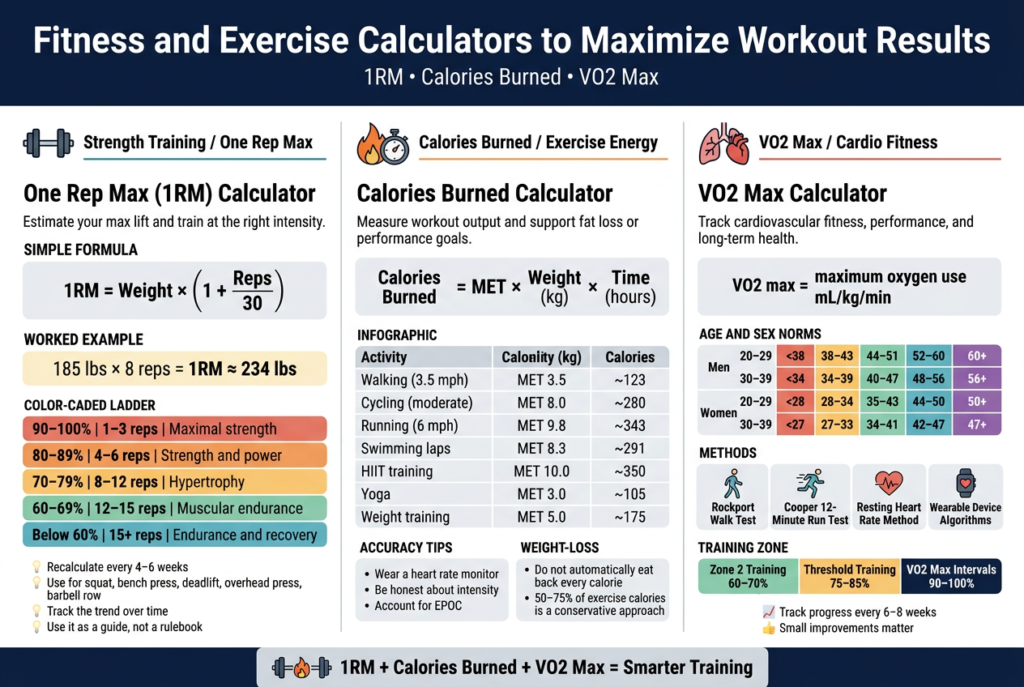
One Rep Max Calculator for Strength Training Progress
If you’ve ever stood in front of a barbell wondering how much weight you should be lifting, a One Rep Max (1RM) calculator is your answer. Your one rep max is the maximum amount of weight you can lift for a single repetition of any given exercise — and knowing this number changes everything about how you train.
Why Your 1RM Matters
Strength training isn’t just about picking up heavy things and putting them down. Smart programming requires working at specific percentages of your maximum capacity. Without knowing your 1RM, you’re essentially guessing, and guessing leads to either undertraining (not enough stimulus for growth) or overtraining (risking injury).
Here’s a quick breakdown of how different percentages of your 1RM target different training goals:
| % of 1RM | Reps per Set | Primary Training Goal |
|---|---|---|
| 90–100% | 1–3 | Maximal strength |
| 80–89% | 4–6 | Strength and power |
| 70–79% | 8–12 | Hypertrophy (muscle size) |
| 60–69% | 12–15 | Muscular endurance |
| Below 60% | 15+ | Endurance and recovery |
How the Calculator Works
You don’t actually need to attempt a true max lift to figure out your 1RM — which is a good thing, because maxing out without a spotter is risky. Instead, the calculator uses submaximal lifts (meaning weights you can move for multiple reps) and plugs them into a formula.
The most widely used formula is the Epley Formula:
1RM = Weight × (1 + Reps / 30)
So if you bench press 185 lbs for 8 reps:
- 1RM = 185 × (1 + 8/30)
- 1RM = 185 × 1.267
- 1RM ≈ 234 lbs
Other popular formulas include the Brzycki, Lander, and Lombardi equations. Most online fitness tracker tools will run multiple formulas simultaneously and give you an average, which improves accuracy.
Practical Tips for Using Your 1RM Data
- Recalculate every 4–6 weeks — as you get stronger, your 1RM changes, and your training weights should shift with it
- Use it for the big compound lifts — squat, bench press, deadlift, overhead press, and barbell row are the most practical applications
- Track the trend over time — a rising 1RM is one of the clearest signs your training is actually working
- Don’t obsess over the exact number — it’s an estimate, not gospel; use it as a guide, not a rulebook
Calories Burned Calculator for Measuring Exercise Effectiveness
Working out feels great, but do you actually know how much energy you’re expending? A workout calorie burn calculator takes the guesswork out of your exercise sessions and gives you a real picture of your energy output — which is especially important if fat loss, performance, or fueling your workouts properly is part of your goal.
What Goes Into the Calculation
The calories you burn during exercise depend on several factors working together:
- Body weight — heavier individuals burn more calories doing the same activity
- Exercise type and intensity — a casual walk burns far fewer calories than a sprint interval session
- Duration — the longer you work, the more energy you expend
- Age and sex — these affect your metabolic rate and how efficiently your body burns fuel
- Fitness level — fitter people sometimes burn calories more efficiently, though intensity adjustments usually compensate for this
Most calorie burn calculators use MET values (Metabolic Equivalent of Task) as their foundation. MET is a measure of how intense an activity is relative to sitting still. The formula looks like this:
Calories Burned = MET × Weight (kg) × Time (hours)
MET Values for Common Exercises
| Activity | MET Value | Calories Burned (70 kg person, 30 min) |
|---|---|---|
| Walking (3.5 mph) | 3.5 | ~123 |
| Cycling (moderate) | 8.0 | ~280 |
| Running (6 mph) | 9.8 | ~343 |
| Swimming laps | 8.3 | ~291 |
| HIIT training | 10.0 | ~350 |
| Yoga | 3.0 | ~105 |
| Weight training | 5.0 | ~175 |
Getting More Accurate Results
No calculator is perfect, but you can get closer to accurate numbers by:
- Wearing a heart rate monitor — pairing heart rate data with calculator estimates significantly improves accuracy
- Being honest about intensity — there’s a big difference between “moderate” and “vigorous” cycling; pick the intensity level that reflects what you actually did
- Accounting for post-exercise calorie burn — high-intensity exercise triggers EPOC (Excess Post-Exercise Oxygen Consumption), meaning your body keeps burning extra calories after you finish; most calculators don’t capture this
How This Connects to Weight Loss Goals
If you’re learning how to use fitness calculators for weight loss, the calorie burn calculator is one of the most practical tools available. By understanding your output side of the energy equation, you can make smarter decisions about your calorie intake calculator targets, ensuring you’re in the right deficit for fat loss without starving yourself or tanking your performance.
A good rule of thumb: don’t automatically eat back every calorie your calculator says you burned. Calculators tend to slightly overestimate, and eating back 50–75% of exercise calories is a more conservative, reliable approach for weight loss.
VO2 Max Calculator for Evaluating Cardiovascular Fitness
VO2 max is arguably the most powerful single number in cardiovascular fitness. It measures your body’s maximum capacity to consume and use oxygen during intense exercise, and it’s one of the strongest predictors of overall health, athletic performance, and even long-term longevity.
The name comes from V (volume), O2 (oxygen), and max (maximum) — together they represent how many milliliters of oxygen your body can process per kilogram of body weight per minute (mL/kg/min).
Why VO2 Max Is Such a Big Deal
Research consistently shows that higher VO2 max scores are linked to:
- Reduced risk of cardiovascular disease
- Lower rates of type 2 diabetes
- Better cognitive function as you age
- Improved physical performance across all sports and activities
- Greater overall life expectancy
Even if you’re not an athlete, understanding where your cardiovascular fitness stands gives you a meaningful baseline to work from.
VO2 Max Norms by Age and Sex
| Age Group | Poor | Fair | Good | Excellent | Superior |
|---|---|---|---|---|---|
| Men 20–29 | <38 | 38–43 | 44–51 | 52–60 | 60+ |
| Men 30–39 | <34 | 34–39 | 40–47 | 48–56 | 56+ |
| Women 20–29 | <28 | 28–34 | 35–43 | 44–50 | 50+ |
| Women 30–39 | <27 | 27–33 | 34–41 | 42–47 | 47+ |
(Values in mL/kg/min)
How VO2 Max Calculators Estimate Your Score
Lab testing for VO2 max requires a treadmill or bike, a mask measuring expired gases, and a sports scientist — not exactly accessible for most people. That’s where calculators come in.
Common estimation methods include:
- The Rockport Walk Test — you walk one mile as fast as possible, record your heart rate at the finish, and plug in your time, weight, age, and sex into a validated formula
- The Cooper 12-Minute Run Test — you run as far as possible in 12 minutes; the distance covered predicts your VO2 max with solid accuracy
- Resting Heart Rate Method — some calculators estimate VO2 max using your resting heart rate and age; it’s the least accurate but requires no physical test
- Wearable device algorithms — smartwatches and fitness tracker tools from brands like Garmin, Apple, and Polar use heart rate variability and workout data to estimate VO2 max continuously
The Rockport and Cooper tests tend to be the most accessible and reasonably accurate for the general population. They won’t match a lab test, but they’re close enough to be genuinely useful for tracking your fitness trends.
Using VO2 Max to Structure Your Cardio Training
Once you have your estimated VO2 max, you can train smarter:
- Zone 2 Training (60–70% of VO2 max intensity) — builds your aerobic base and mitochondrial density; this is the foundation of all endurance fitness
- Threshold Training (75–85% of VO2 max intensity) — improves the pace you can sustain without accumulating too much lactate
- VO2 Max Intervals (90–100% of VO2 max intensity) — short, hard efforts that directly challenge and improve your maximal aerobic capacity
A balanced cardio program hitting all three zones will push your VO2 max upward over time. Most people see meaningful improvements within 8–12 weeks of consistent, structured training.
- Track progress every 6–8 weeks by repeating the same test under the same conditions
- Pair VO2 max data with your other health and fitness calculators — body composition data, calorie intake numbers, and heart rate zones all tell a more complete story together
- Remember that any improvement is significant — research suggests even small increases in VO2 max carry substantial health benefits, regardless of your starting point
Health Risk Calculators That Help You Stay One Step Ahead
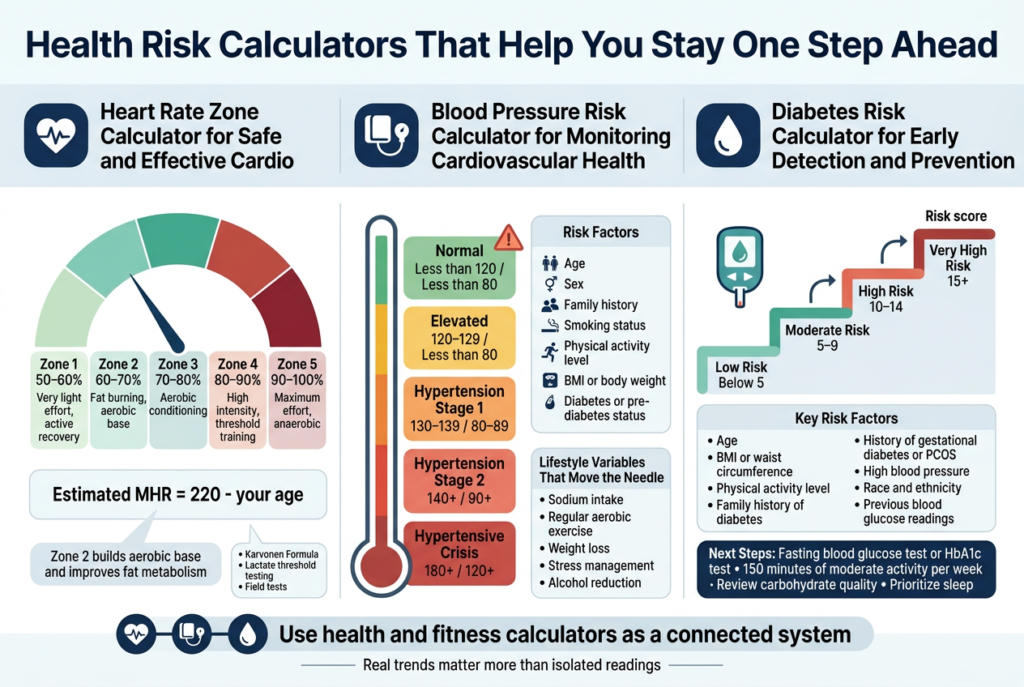
Heart Rate Zone Calculator for Safe and Effective Cardio
Your heart rate tells a story during every workout — and if you’re not listening to it, you’re probably either pushing too hard, not hard enough, or both on alternating days. A heart rate zone calculator takes the guesswork out of cardio by mapping your effort levels to specific physiological outcomes.
How Heart Rate Zones Work
Heart rate zones are typically divided into five ranges, each based on a percentage of your maximum heart rate (MHR). The most common formula for estimating MHR is:
220 minus your age
So a 35-year-old would have an estimated MHR of 185 BPM.
| Zone | % of Max HR | What’s Happening in Your Body | Best For |
|---|---|---|---|
| Zone 1 | 50–60% | Very light effort, active recovery | Warm-up, cool-down |
| Zone 2 | 60–70% | Fat burning, building aerobic base | Long slow runs, easy cycling |
| Zone 3 | 70–80% | Aerobic conditioning, improved endurance | Moderate cardio sessions |
| Zone 4 | 80–90% | High intensity, lactate threshold training | Speed work, interval training |
| Zone 5 | 90–100% | Maximum effort, anaerobic | Short sprints, competitive racing |
Why Zone 2 Gets So Much Attention
Zone 2 training has picked up serious momentum in the endurance and longevity communities — and for good reason. Training at 60–70% of your max heart rate builds mitochondrial density, improves fat metabolism, and strengthens your cardiovascular system without hammering your recovery capacity.
Many recreational athletes spend too much time in Zone 3 — what coaches often call the “junk miles” zone — where you’re working hard enough to feel tired but not hard enough to drive meaningful adaptation. A heart rate zone calculator keeps you honest.
Getting a More Accurate Zone Calculation
The standard 220-minus-age formula is a decent starting point, but it has a margin of error of plus or minus 10–12 BPM. More accurate alternatives include:
- Karvonen Formula — factors in your resting heart rate for a personalized calculation
- Lactate threshold testing — done in a lab or with a trained coach
- Field tests — like a 30-minute time trial where your average heart rate in the final 20 minutes approximates threshold
Using these health and fitness calculators alongside a heart rate monitor during your workouts gives you real-time feedback you can actually act on.
Blood Pressure Risk Calculator for Monitoring Cardiovascular Health
High blood pressure — or hypertension — is called the “silent killer” because it rarely comes with warning signs until serious damage has already been done. A blood pressure risk calculator gives you a way to assess where you stand and understand what your numbers actually mean for your long-term cardiovascular health.
Reading the Numbers the Right Way
Blood pressure is expressed as two numbers:
- Systolic pressure — the top number, measuring pressure when your heart beats
- Diastolic pressure — the bottom number, measuring pressure between beats
| Category | Systolic (mmHg) | Diastolic (mmHg) | What It Means |
|---|---|---|---|
| Normal | Less than 120 | Less than 80 | Healthy range, keep it up |
| Elevated | 120–129 | Less than 80 | Watch your lifestyle habits |
| Hypertension Stage 1 | 130–139 | 80–89 | Lifestyle changes recommended |
| Hypertension Stage 2 | 140+ | 90+ | Medical attention needed |
| Hypertensive Crisis | 180+ | 120+ | Seek emergency care immediately |
What a Blood Pressure Risk Calculator Actually Measures
Beyond just reading your numbers, a solid blood pressure risk calculator factors in additional variables that influence your cardiovascular risk profile:
- Age — risk naturally climbs with age
- Sex — men tend to develop hypertension earlier; post-menopausal women catch up quickly
- Family history — genetics play a significant role
- Smoking status
- Physical activity level
- BMI or body weight
- Diabetes or pre-diabetes status
When you combine these factors, the calculator can estimate your 10-year cardiovascular risk, which is far more useful than a single blood pressure reading on a given day.
Lifestyle Variables That Move the Needle
The good news is that blood pressure responds to lifestyle changes faster than most people expect. Key areas to focus on include:
- Sodium intake — cutting sodium by 1,000 mg per day can drop systolic pressure by 5–6 mmHg
- Regular aerobic exercise — consistent cardio can lower systolic BP by 5–8 mmHg
- Weight loss — losing 5–10% of body weight has a measurable impact
- Stress management — chronic stress keeps cortisol and blood pressure elevated
- Alcohol reduction — more than two drinks per day raises blood pressure over time
Tracking your readings over time and using a health risk assessment tool to contextualize those numbers helps you see trends instead of reacting to isolated data points.
Diabetes Risk Calculator for Early Detection and Prevention
Type 2 diabetes affects hundreds of millions of people worldwide, and a significant number of those cases were preventable. What makes it so dangerous is that pre-diabetes — the stage where blood sugar is elevated but not yet in the diabetic range — causes no obvious symptoms. A diabetes risk calculator can flag your risk level years before a clinical diagnosis, which is exactly when lifestyle intervention is most powerful.
Key Risk Factors the Calculator Weighs
A well-designed diabetes risk calculator pulls from a range of inputs:
- Age — risk increases significantly after 45
- BMI or waist circumference — visceral fat around the abdomen is particularly linked to insulin resistance
- Physical activity level — sedentary individuals carry substantially higher risk
- Family history of diabetes
- History of gestational diabetes or polycystic ovary syndrome (PCOS)
- High blood pressure
- Race and ethnicity — certain populations carry genetically elevated risk
- Previous blood glucose readings — if available
Understanding Your Risk Score
Most diabetes risk calculators produce a score that places you in one of several categories:
| Risk Level | Score Range | Recommended Action |
|---|---|---|
| Low Risk | Below 5 | Maintain healthy habits, retest in 3 years |
| Moderate Risk | 5–9 | Lifestyle improvements recommended, consult a doctor |
| High Risk | 10–14 | Medical evaluation and blood glucose testing advised |
| Very High Risk | 15+ | Immediate medical consultation and testing |
(Scoring scales vary by calculator — the American Diabetes Association’s online tool and the CDC’s Prediabetes Risk Test are among the most commonly referenced.)
What Happens After You Get Your Score
Getting a high-risk result from a diabetes risk calculator isn’t a diagnosis — it’s a heads-up. Here’s what typically makes sense as a next step:
- Schedule a fasting blood glucose test or HbA1c test with your doctor
- Start tracking daily movement — even 150 minutes of moderate activity per week reduces diabetes risk by up to 58% according to landmark prevention studies
- Review your carbohydrate quality — not just quantity, but the glycemic load of what you’re eating
- Prioritize sleep — poor sleep quality directly impairs insulin sensitivity
The Diabetes Prevention Program (DPP), one of the most cited studies in preventive medicine, demonstrated that modest lifestyle changes — losing 5–7% of body weight and walking 30 minutes most days — cut the progression from pre-diabetes to type 2 diabetes nearly in half.
How This Connects to the Bigger Picture of Wellness Calculators
A diabetes risk calculator doesn’t work in isolation. Pairing it with a BMI calculator, a calorie intake calculator, and fitness tracker tools gives you a much more complete picture of where you stand and what levers you can pull. When you see how your body composition, eating habits, and activity levels all feed into the same downstream health risks, the data stops feeling abstract and starts feeling actionable.
Using health and fitness calculators as a connected system — rather than isolated check-ins — is what separates people who see real change from those who collect numbers and do nothing with them.
How to Apply Calculator Results to Your Daily Wellness Routine
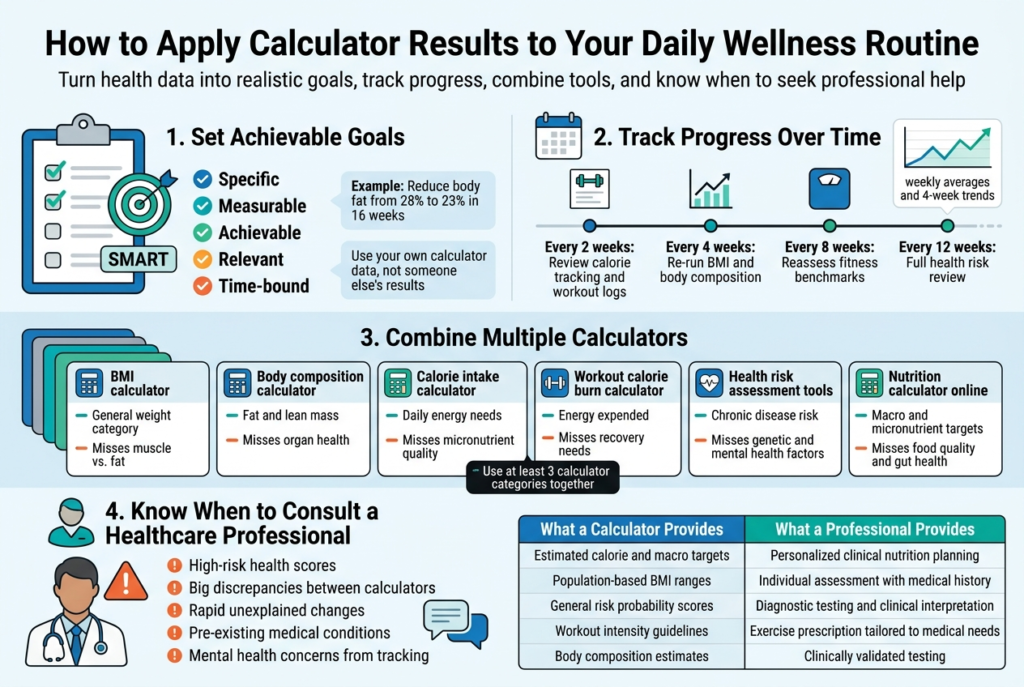
Setting Achievable Goals Based on Your Personal Data
Raw numbers from health and fitness calculators are only useful when you actually do something with them. Once you have your BMI, body fat percentage, daily calorie needs, and heart rate zones in front of you, the next move is turning those figures into goals that are realistic enough to stick with.
Start by identifying your single biggest priority. Trying to lose weight, build muscle, lower blood pressure risk, and improve cardiovascular fitness all at once is a recipe for burnout. Pick the metric that matters most to your health right now and build your first goal around that one number.
How to Build Goals That Actually Hold Up
Use the SMART framework as your starting point, but feed it with your personal calculator data instead of generic recommendations:
- Specific: Instead of “I want to lose weight,” try “I want to reduce my body fat percentage from 28% to 23% over 16 weeks.”
- Measurable: Tie your goal to a number your calculators can track — calories consumed per day, weekly workout minutes, or waist circumference changes.
- Achievable: A calorie intake calculator showing your maintenance level is 2,400 calories means a target of 1,900–2,000 calories is sustainable. Dropping to 1,200 is not.
- Relevant: Your goal should match your health data. If your health risk assessment flags blood pressure concerns, prioritizing cardiovascular exercise beats focusing purely on aesthetics.
- Time-bound: Set a checkpoint date. Four to eight weeks is long enough to see meaningful change but short enough to stay motivated.
Calorie and Fitness Targets to Keep in Mind
| Goal | Calculator to Use | Realistic Target |
|---|---|---|
| Weight loss | Calorie intake calculator | 500–750 calorie daily deficit |
| Muscle gain | Macro/nutrition calculator | 200–300 calorie daily surplus |
| Improve cardiovascular health | Heart rate zone calculator | 150+ min/week in moderate zone |
| Reduce body fat | Body composition calculator | 0.5–1% body fat per month |
| Lower health risk scores | Health risk assessment tools | Reassess every 8–12 weeks |
One thing people consistently get wrong is setting goals based on someone else’s results. Your neighbor losing 20 pounds in two months has a completely different body composition, metabolic rate, and starting point. Your calculator results are yours — build goals around them, not around what you see on social media.
Tracking Progress Over Time for Consistent Improvement
A single snapshot from any wellness calculator is interesting. A series of snapshots taken over weeks and months is genuinely powerful. Tracking your data over time is what transforms a one-off calculation into a real picture of your health trajectory.
The key is consistency in how and when you collect your measurements. Weigh yourself at the same time of day, run your body composition calculator under the same conditions, and log your workouts using the same workout calorie burn calculator each time. Small variations in method create noise in your data that can make real progress look invisible.
Building a Simple Tracking System
You don’t need an elaborate spreadsheet or an expensive app. A basic tracking system should capture:
- Weekly weight and body measurements — waist, hips, chest, arms
- Monthly body fat percentage using a body composition calculator
- Daily or weekly calorie intake logged through a nutrition calculator online
- Workout data — duration, intensity, and calories burned per session
- Health risk scores — reassessed every 8 to 12 weeks
Recognizing Real Progress vs. Normal Fluctuation
Body weight can swing 2–4 pounds in a single day based on water retention, sodium intake, and hormonal shifts. If you check your weight daily and panic at every uptick, you will exhaust yourself. Instead, track weekly averages and look at the four-week trend line.
The same logic applies to fitness tracker tools. A single bad workout doesn’t erase your progress. What matters is whether your average performance over the past month is better than your average performance the month before.
Here are the checkpoints worth building into your calendar:
- Every 2 weeks: Review calorie tracking and workout logs for patterns
- Every 4 weeks: Re-run your BMI calculator and body composition calculator
- Every 8 weeks: Reassess your fitness benchmarks — max heart rate performance, strength levels, endurance
- Every 12 weeks: Complete a full health risk assessment review and adjust goals accordingly
Progress is rarely linear. Plateaus happen. But if you have consistent data, you can spot a plateau early and adjust your approach rather than abandoning the plan entirely.
Combining Multiple Calculators for a Complete Health Picture
No single health or fitness calculator tells the whole story. A BMI calculator might flag you as overweight while a body composition calculator shows your body fat percentage is perfectly healthy and you’re simply carrying more muscle mass. Using just one tool and treating its output as the final word is a mistake.
The real power comes from layering calculator results together so that they check and balance each other.
How Different Calculators Work Together
| Calculator Type | What It Tells You | What It Misses |
|---|---|---|
| BMI calculator | General weight category relative to height | Muscle vs. fat distribution |
| Body composition calculator | Actual fat and lean mass percentages | Organ health, visceral fat depth |
| Calorie intake calculator | Daily energy needs for your goal | Micronutrient quality, meal timing |
| Workout calorie burn calculator | Energy expended during exercise | Recovery needs, training stress |
| Health risk assessment tools | Probability of chronic disease risk factors | Genetic predispositions, mental health |
| Nutrition calculator online | Macro and micronutrient targets | Food quality, gut health factors |
When you read these results together, patterns emerge that no single tool would reveal on its own. For example:
- A high BMI paired with low body fat percentage suggests high muscle mass — not a health concern
- A healthy BMI paired with high body fat percentage (a pattern called “normal weight obesity”) can actually carry significant metabolic health risks
- Meeting your calorie targets but consistently under-recovering from workouts might mean your macro split needs adjusting, even if total calories look right
- Low workout calorie burn combined with a large calorie deficit could put you in a state of under-fueling that slows metabolism over time
A Practical Layered Approach
Start each wellness review session by pulling numbers from at least three different calculator categories — body composition, nutrition, and fitness performance. Compare them side by side before making any changes to your plan. If two or more calculators point toward the same issue, that’s a reliable signal. If only one metric looks off, dig into the methodology before overhauling everything.
Using health and fitness calculators as a complete toolkit — rather than relying on just one or two — gives you the kind of multi-dimensional view that actually reflects how the human body works.
Knowing When to Consult a Healthcare Professional
Wellness calculators are genuinely excellent tools. They are accessible, fast, and based on population-level data that can give you meaningful directional guidance. But there are clear situations where a calculator result should send you straight to a qualified professional rather than prompting a DIY adjustment.
Situations That Call for a Professional Conversation
1. Health risk scores that land in high-risk categories
If your health risk assessment tools return scores indicating elevated risk for cardiovascular disease, type 2 diabetes, or hypertension, that’s not a cue to start a new diet program on your own. That’s a cue to book an appointment with your doctor and get proper bloodwork and clinical evaluation done.
2. Significant discrepancies between calculators
When your body composition calculator and your calorie intake calculator are pointing in completely different directions — for example, you’re eating in a consistent deficit but gaining body fat — something metabolic may be going on that requires a clinical workup.
3. Rapid unexplained changes in your data
Sudden large shifts in weight, body composition, or resting heart rate that you can’t connect to a change in your habits deserve professional attention. Calculators can track these shifts but they cannot diagnose them.
4. Pre-existing medical conditions
If you have diabetes, heart disease, kidney disease, or any condition affecting metabolism, you should not rely on general online calculators to set your nutrition and exercise targets. These conditions change how your body processes calories, macronutrients, and physical stress in ways that standard formulas do not account for.
5. Mental health concerns related to tracking
If monitoring calorie intake, body weight, or body fat percentage is causing anxiety, obsessive behavior, or distress, that’s an important signal to step back from calculators entirely and talk to a mental health professional. Fitness tracker tools are designed to support wellness, not undermine it.
What Professionals Can Offer That Calculators Cannot
| What a Calculator Provides | What a Professional Provides |
|---|---|
| Estimated calorie and macro targets | Personalized clinical nutrition planning |
| Population-based BMI reference ranges | Individual assessment considering medical history |
| General health risk probability scores | Diagnostic testing and clinical interpretation |
| Workout intensity guidelines | Exercise prescription tailored to medical needs |
| Body composition estimates | Clinically validated body composition testing (DEXA, BodPod) |
Think of health and fitness calculators as the starting conversation and a healthcare professional as the person who helps you understand the full story. The two work better together than either does alone.
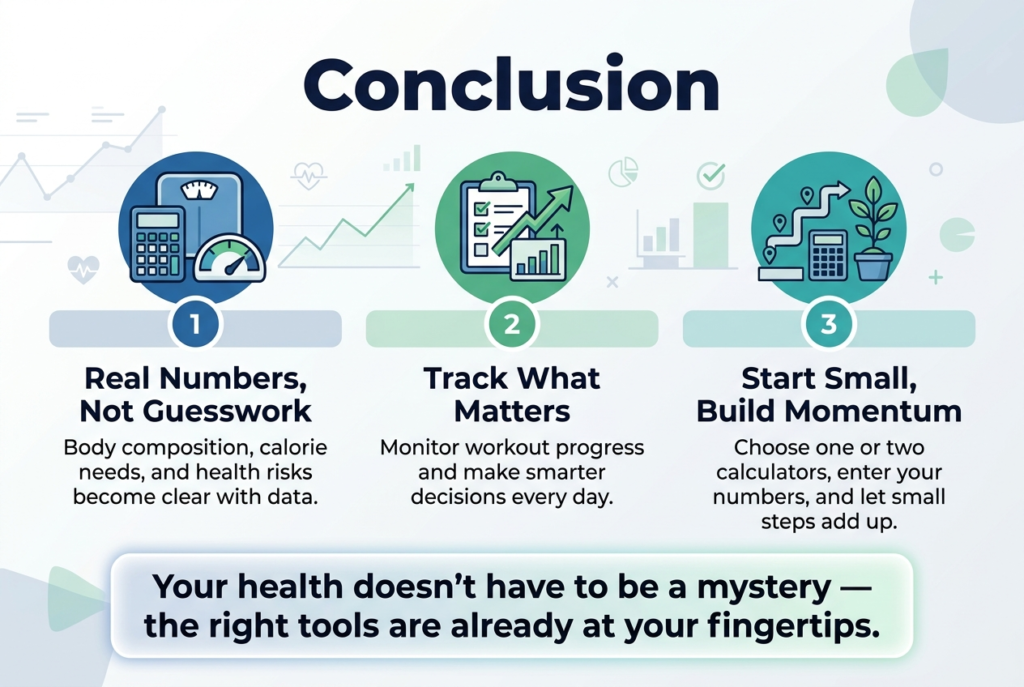
Health and fitness calculators take the guesswork out of your wellness journey. From understanding your body composition to figuring out exactly how many calories you need, these tools give you real numbers to work with instead of vague estimates. Knowing your health risks ahead of time and tracking your workout progress means you can make smarter decisions every single day — not just when something feels off.
The best part? You don’t need to overhaul your entire lifestyle overnight. Start with one or two calculators that feel most relevant to where you are right now, plug in your numbers, and let the data guide your next small step. Over time, those small steps add up to big changes. Your health doesn’t have to be a mystery — the right tools are already at your fingertips.