The post explains how financial calculators help people make clearer money decisions by turning budgeting, savings, debt, investment, retirement, tax, and insurance questions into specific numbers. It emphasises choosing the right calculator for each goal and using reliable, customizable tools.
It also reviews major calculator types, shows what each one measures, and compares free and paid options. The post closes by recommending that readers start with the tools that match their most urgent financial priorities.
Financial Calculators: Which Ones Do You Actually Need?
If you’ve ever stared at a spreadsheet wondering whether you’re saving enough, borrowing too much, or investing too little — you’re not alone. Most people know they should be on top of their finances, but figuring out where to start feels overwhelming without the right tools.
That’s exactly where financial calculators come in.
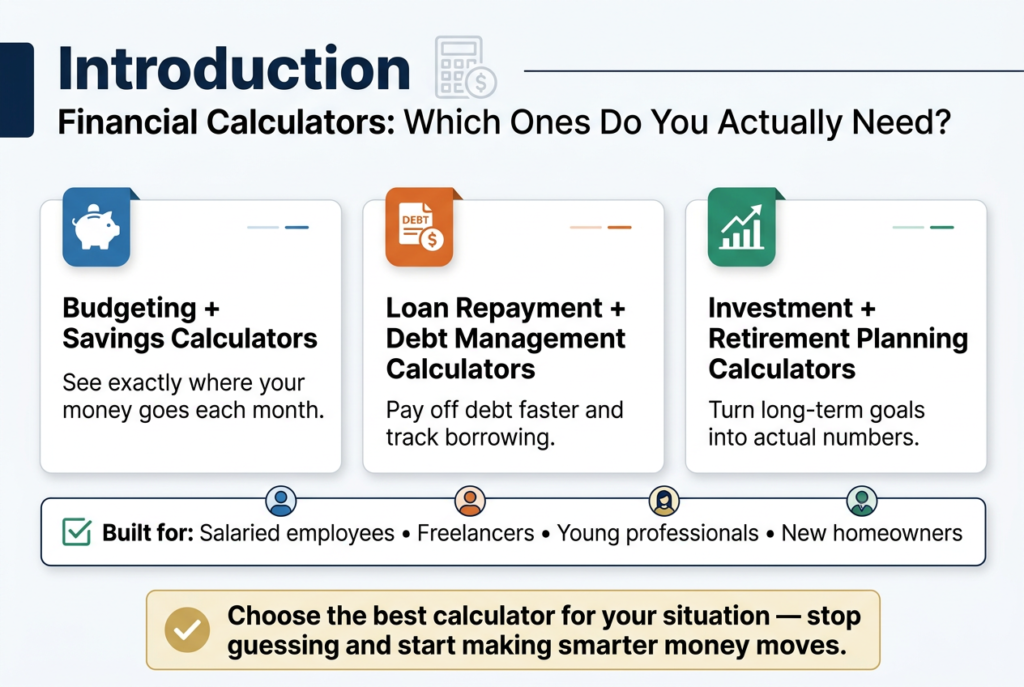
This guide is for everyday people — salaried employees, freelancers, young professionals, new homeowners — anyone who wants to make smarter money decisions without hiring a financial advisor for every question.
Here’s what we’ll walk through together:
- Budgeting and savings calculators that show you exactly where your money goes each month
- Loan repayment calculators and debt management calculators that help you escape debt faster
- Investment calculators and retirement planning calculators that turn your long-term goals into actual numbers
By the end, you’ll also know how to choose the best financial calculator for your specific situation — so you stop guessing and start making moves that actually work for your wallet.
Let’s get into it.
Understanding Financial Calculators and Their Importance
How Financial Calculators Simplify Complex Money Decisions
Money math can get messy fast. Whether you’re trying to figure out how long it’ll take to pay off a credit card, how much house you can actually afford, or what your retirement savings need to look like, doing all that math by hand is slow, tedious, and honestly pretty error-prone.
Financial calculators take those complicated formulas — the ones involving compound interest, amortisation schedules, tax brackets, and investment growth projections — and turn them into something anyone can work with in under a minute. You plug in your numbers, hit calculate, and get a clear picture of where you stand.
Here’s what financial calculators actually help you do:
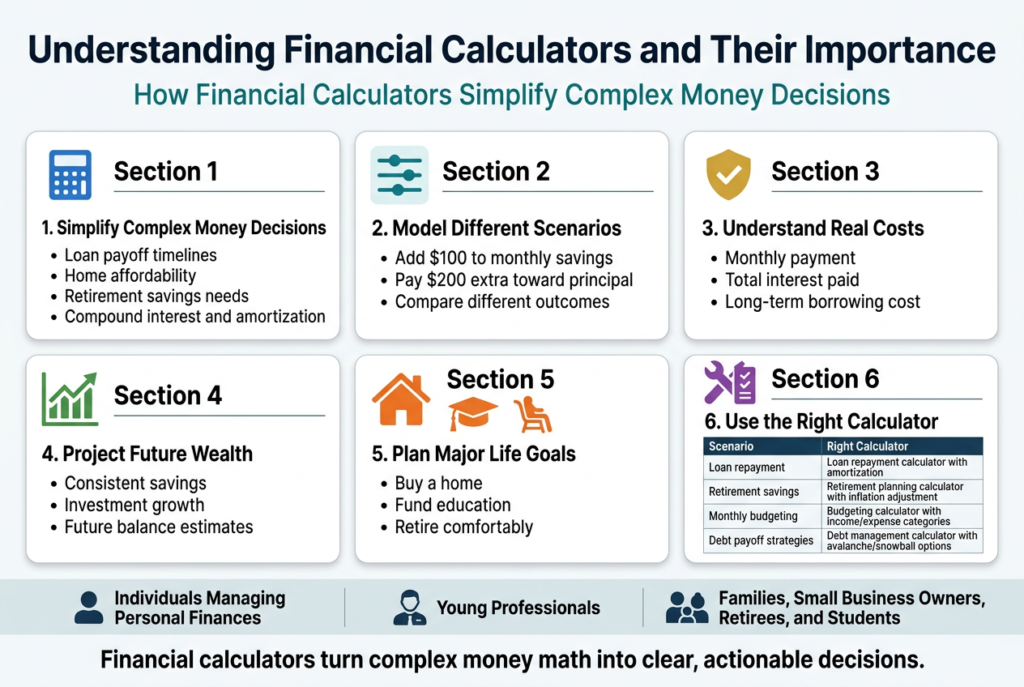
- Break down big financial decisions into simple inputs and readable outputs
- Model different scenarios — like what happens if you increase your monthly savings by $100 or pay an extra $200 toward your loan principal
- Understand the real cost of borrowing — not just the monthly payment, but the total interest paid over the life of a loan
- Project future wealth based on consistent savings and investment habits
- Plan for major life events like buying a home, funding education, or retiring comfortably
The best financial calculators don’t just crunch numbers — they help you see the relationship between your decisions and their long-term outcomes. That kind of clarity is hard to get from a spreadsheet unless you really know what you’re doing.
Why Using the Right Calculator Saves Time and Reduces Errors
Not all financial calculators are created equal, and using the wrong one — or a poorly designed one — can actually lead you in the wrong direction.
Think about it this way: if you use a basic savings calculator to estimate your investment returns, it probably won’t account for things like compound growth frequency, inflation, or contribution timing. The number it spits out could be wildly off from reality, and you’d have no idea.
Using the right calculator matters because:
| Scenario | Wrong Calculator | Right Calculator |
|---|---|---|
| Planning loan repayment | Basic interest calculator | Loan repayment calculator with amortisation |
| Estimating retirement savings | Simple savings tool | Retirement planning calculator with inflation adjustment |
| Budgeting monthly expenses | Generic math tool | Budgeting calculator with income/expense categories |
| Comparing debt payoff strategies | None | Debt management calculator with avalanche/snowball options |
The right tool also saves you a significant amount of time. Instead of building formulas in a spreadsheet (and second-guessing whether you got them right), a purpose-built financial calculator walks you through exactly what data you need to enter and gives you results in a format that’s easy to understand and act on.
Accuracy matters even more when the stakes are high. A small mistake in a retirement planning calculator could mean underestimating how much you need to save by tens of thousands of dollars. Getting it right from the start, with a reliable and well-designed tool, is always worth the few extra minutes it takes to find the right one.
Who Benefits Most from Financial Calculators
The honest answer? Pretty much everyone who deals with money — which is all of us. But certain groups get especially outsized value from using these tools regularly.
Individuals Managing Personal Finances
If you’re budgeting on a single or dual income, trying to get out of debt, or just starting to build savings, financial calculators help you set realistic goals and actually understand whether your current habits will get you there. A savings calculator online, for example, can show someone saving $300 a month exactly how many years it’ll take to hit a $20,000 emergency fund target.
Young Professionals Just Starting Out
People in their 20s and early 30s are making some of the biggest financial decisions of their lives — student loan repayment, first cars, first apartments or homes, early investing. Having access to a loan repayment calculator or an investment calculator at this stage can shape habits and decisions that compound (literally) over decades.
Families Planning for the Future
Families juggling mortgage payments, childcare costs, college savings, and retirement contributions have a lot of moving parts. Calculators help them prioritize — for example, figuring out whether to pay down the mortgage faster or redirect extra cash into a retirement account.
Small Business Owners
Business owners often need to quickly estimate tax liabilities, evaluate financing options for equipment or expansion, or project cash flow. A tax calculator tool or a debt management calculator can support faster, better-informed decisions without requiring a call to an accountant every time.
People Approaching Retirement
Anyone within 10-15 years of retirement should be running numbers regularly. A retirement planning calculator helps determine whether current savings rates are on track, how different withdrawal strategies affect longevity of funds, and what Social Security timing might mean for total lifetime income.
Students and Financial Beginners
Financial calculators are a fantastic learning tool. They make abstract concepts like compound interest and loan amortization tangible and real. Someone who’s never thought about how a credit card’s minimum payment keeps them in debt for years will get it immediately when they see the numbers laid out by a good calculator.
The bottom line is that financial calculators aren’t just for finance professionals or number nerds. They’re practical, accessible tools that help real people make smarter decisions with their money — at every income level and every stage of life.
Must-Have Budgeting and Savings Calculators
Budget Calculators to Take Control of Monthly Expenses
Getting a clear picture of where your money goes every month is the first step toward actually doing something about it. Budget calculators make this incredibly easy by helping you map out your income, fixed expenses, variable spending, and what’s left over — all in one place.
Here’s what a good budgeting calculator typically helps you track:
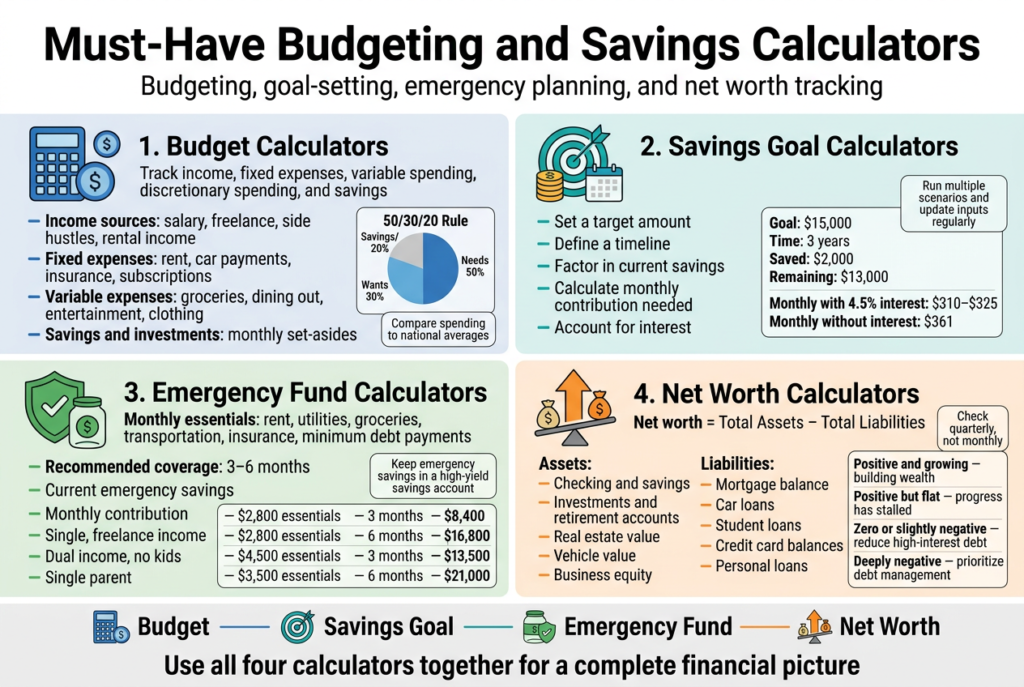
- Income sources — salary, freelance work, side hustles, rental income
- Fixed expenses — rent/mortgage, car payments, insurance premiums, subscriptions
- Variable expenses — groceries, dining out, entertainment, clothing
- Discretionary spending — travel, hobbies, personal care
- Savings and investments — how much you’re setting aside each month
One of the most popular frameworks built into many budgeting calculators is the 50/30/20 rule, which splits your after-tax income like this:
| Category | Percentage | What It Covers |
|---|---|---|
| Needs | 50% | Rent, utilities, groceries, transportation |
| Wants | 30% | Dining out, streaming, hobbies |
| Savings/Debt | 20% | Emergency fund, investments, debt payoff |
The real power of budgeting calculators comes from running them consistently — not just once. When you plug in your actual numbers monthly, patterns start to emerge. Maybe you’re spending way more on food delivery than you realized, or your subscription costs have quietly ballooned. These calculators put those patterns right in front of your face.
Some of the best budgeting calculators online also let you compare your spending against national averages for your income bracket, which gives you a useful reality check on whether you’re overspending in certain categories.
Savings Goal Calculators to Reach Financial Targets Faster
Whether you’re saving for a vacation, a down payment on a house, a new car, or your kid’s college fund, a savings goal calculator turns a vague dream into a concrete plan with actual numbers attached to it.
Here’s what these calculators do for you:
- Set a clear target amount — exactly how much you need
- Define a timeline — when you want to hit that goal
- Factor in your current savings — what you’re starting with
- Calculate the monthly contribution needed — so you know exactly what to set aside
- Account for interest — if your savings are in a high-yield account, that interest compounds and helps you get there faster
How a Savings Calculator Works in Real Life
Say you want to save $15,000 for a house down payment in 3 years. You already have $2,000 saved, and your high-yield savings account earns 4.5% annual interest.
A savings calculator online would tell you:
- Remaining amount needed: $13,000
- With compound interest at 4.5%: You’d need to save roughly $310–$325 per month
- Without interest: You’d need to save around $361 per month
That difference matters. Knowing the exact monthly number removes the guesswork and makes it far easier to adjust your budget accordingly.
Tips for Getting the Most Out of Savings Calculators
- Always use realistic interest rates — don’t assume the highest possible return
- Run multiple scenarios (what if you save more? what if your timeline shifts?)
- Update your inputs whenever your income or expenses change
- Use them alongside budgeting calculators so your savings goal fits neatly into your monthly plan
Emergency Fund Calculators to Build a Financial Safety Net
An emergency fund is one of those things everyone knows they should have, but many people never actually build. Emergency fund calculators cut through the overwhelm by giving you a specific, personalized savings target rather than the generic “save 3–6 months of expenses” advice.
What Goes Into an Emergency Fund Calculation
The calculator pulls together:
- Monthly essential expenses — rent/mortgage, utilities, groceries, transportation, insurance, minimum debt payments
- Number of months to cover — typically 3 months for dual-income households, 6 months for single-income or variable-income earners
- Current emergency savings — what you already have set aside
- Monthly contribution — what you can realistically put away each month
- Time to reach the goal — based on your contribution rate
Here’s a quick example of how the math shakes out for different household types:
| Household Type | Monthly Essentials | Recommended Coverage | Emergency Fund Target |
|---|---|---|---|
| Single, stable job | $2,800 | 3 months | $8,400 |
| Single, freelance income | $2,800 | 6 months | $16,800 |
| Dual income, no kids | $4,500 | 3 months | $13,500 |
| Single parent | $3,500 | 6 months | $21,000 |
Why These Calculators Are So Useful
Most people underestimate their monthly essentials because they forget things like car insurance, phone bills, or streaming subscriptions they’d keep even in a crisis. A good emergency fund calculator forces you to list every essential expense, so your target is actually accurate — not just a rough guess.
It also helps you figure out a realistic monthly saving rate to build that fund without completely wrecking your budget. Some calculators even let you see how long it would take to reach your target at different saving rates, which is great motivation to push yourself to save a little more each month.
Keep your emergency fund in a high-yield savings account, completely separate from your checking account. This way it earns a little interest while staying accessible when you actually need it.
Net Worth Calculators to Track Overall Financial Health
Your net worth is the single most honest snapshot of your financial health. It’s simple: what you own minus what you owe. A net worth calculator pulls all of that together in one clean number, and tracking it over time shows whether you’re genuinely making financial progress.
Assets vs. Liabilities — What Gets Counted
Assets (what you own):
- Checking and savings account balances
- Investment and retirement account balances (401k, IRA, brokerage accounts)
- Real estate value
- Vehicle value
- Business equity
- Other valuable property (jewelry, collectibles, etc.)
Liabilities (what you owe):
- Mortgage balance
- Car loans
- Student loans
- Credit card balances
- Personal loans
- Any other outstanding debts
Net Worth = Total Assets − Total Liabilities
Reading Your Net Worth Number
| Net Worth Result | What It Means |
|---|---|
| Positive and growing | You’re building wealth — keep going |
| Positive but flat | Progress has stalled — review your savings and debt payoff strategy |
| Zero or slightly negative | Common early in adulthood — focus on reducing high-interest debt |
| Deeply negative | High-interest debt is likely eating your financial progress — prioritize debt management |
A negative net worth isn’t a disaster — especially if you’re young or carrying student loans. What matters most is the trajectory. Are you moving in the right direction month after month?
How Often Should You Calculate Net Worth?
Most financial experts recommend checking your net worth quarterly rather than monthly. Monthly swings can feel discouraging because investment accounts fluctuate with the market. A quarterly check-in gives you a steadier view of genuine progress.
Many of the best financial calculators available today let you save your inputs and track changes over time, which turns your net worth calculation into a real financial tracking tool rather than just a one-time exercise. When you combine this with budgeting calculators and savings goal tools, you get a complete picture of where you stand today and exactly where you’re headed.
Essential Loan and Debt Management Calculators
Loan Payment Calculators to Plan Borrowing Smartly
Taking on debt without doing the math first is like driving somewhere new without a map — you might eventually get there, but you’ll probably take a few wrong turns along the way. A loan repayment calculator takes the guesswork out of borrowing by showing you exactly what you’re signing up for before you put pen to paper.
Here’s what a good loan payment calculator helps you figure out:
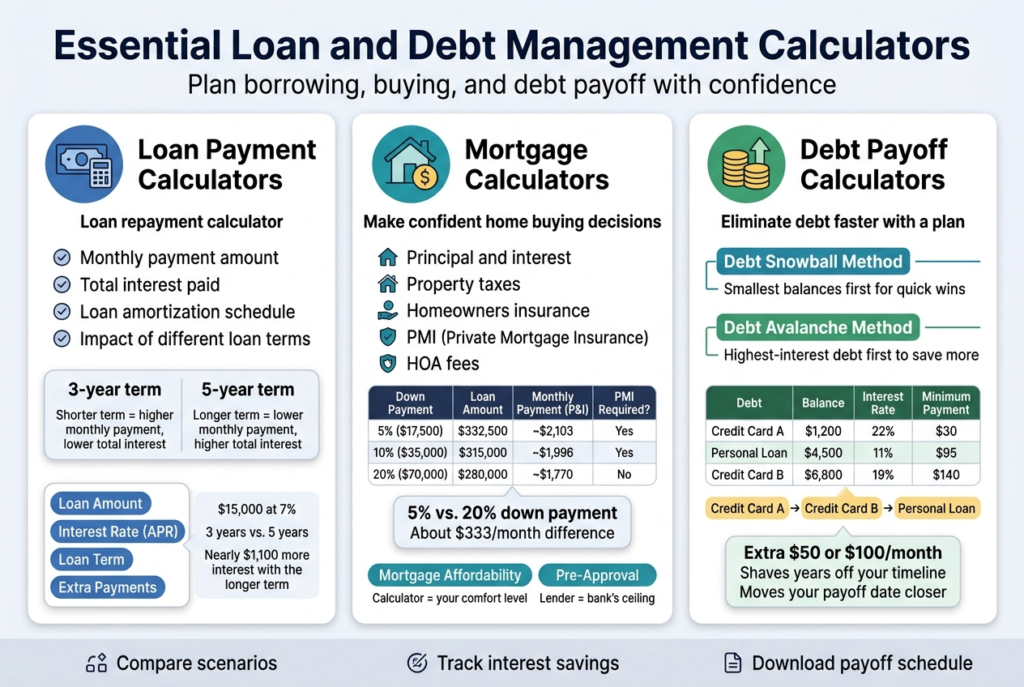
- Monthly payment amount — Know upfront what’s coming out of your pocket every month
- Total interest paid — This number often shocks people, and rightfully so
- Loan amortization schedule — A breakdown of how each payment is split between principal and interest over time
- Impact of different loan terms — See how choosing a 3-year vs. a 5-year term changes both your monthly payment and total cost
Key Variables to Plug Into a Loan Calculator
| Variable | Why It Matters |
|---|---|
| Loan Amount | The principal you’re borrowing |
| Interest Rate (APR) | Determines the cost of borrowing |
| Loan Term | Longer terms = lower payments but more interest |
| Extra Payments | Shows how paying more monthly shortens your loan |
The real power of these financial calculators shows up when you start comparing scenarios side by side. For example, borrowing $15,000 at 7% over 3 years versus 5 years might feel like a small difference — until you see you’d pay nearly $1,100 more in interest with the longer term. That kind of clarity changes decisions.
A loan payment calculator is also your best friend when negotiating with lenders. You walk in knowing what a fair deal looks like, which puts you in a much stronger position.
Mortgage Calculators to Make Confident Home Buying Decisions
Buying a home is likely the biggest financial commitment you’ll ever make, and a mortgage calculator is one of the best tools to help you avoid getting in over your head. These aren’t just simple payment estimators — a solid mortgage calculator accounts for several layers of real-world costs that many first-time buyers forget to factor in.
What a Good Mortgage Calculator Covers
- Principal and interest — The base of every monthly payment
- Property taxes — Varies by location and can significantly raise your monthly cost
- Homeowners insurance — Required by most lenders and often underestimated
- PMI (Private Mortgage Insurance) — Applies when your down payment is less than 20%
- HOA fees — Relevant if you’re buying in a managed community
Here’s a quick look at how down payment size impacts monthly payments on a $350,000 home at a 6.5% interest rate over 30 years:
| Down Payment | Loan Amount | Monthly Payment (P&I) | PMI Required? |
|---|---|---|---|
| 5% ($17,500) | $332,500 | ~$2,103 | Yes |
| 10% ($35,000) | $315,000 | ~$1,996 | Yes |
| 20% ($70,000) | $280,000 | ~$1,770 | No |
That extra $333/month difference between a 5% and 20% down payment is significant — and seeing it laid out clearly in a calculator helps you decide whether to wait and save more or move forward now.
Mortgage Affordability vs. Pre-Approval
One thing worth understanding is the difference between what a mortgage calculator says you can afford and what a lender pre-approves you for. Lenders look at your debt-to-income ratio and credit score, but they won’t factor in your lifestyle, future goals, or other expenses. A calculator lets you set your own comfort level, not just hit the bank’s ceiling.
Beyond purchase decisions, mortgage calculators are also handy for:
- Refinancing decisions — Figuring out if switching to a lower rate actually saves money after closing costs
- Extra payment analysis — Seeing how much time and interest you’d save by adding even $100/month to your principal
- Rent vs. buy comparisons — Some advanced tools let you weigh both options side by side
Debt Payoff Calculators to Eliminate Debt Faster
Debt has a sneaky way of sticking around longer than expected — partly because minimum payments barely dent the principal, and partly because most people don’t have a clear plan. A debt management calculator changes that by turning a vague “I need to pay this off” intention into a concrete, month-by-month roadmap.
Two Popular Debt Payoff Strategies You Can Model
1. Debt Snowball Method
Pay off your smallest balances first for quick psychological wins. A snowball calculator lines up your debts from smallest to largest and shows you how freed-up minimum payments roll into the next debt once one is cleared.
2. Debt Avalanche Method
Target the highest-interest debt first to minimize total interest paid. An avalanche calculator does the math to show you exactly how much money you save compared to the snowball method.
Here’s a simplified comparison to show how strategy choice affects outcomes:
| Debt | Balance | Interest Rate | Minimum Payment |
|---|---|---|---|
| Credit Card A | $1,200 | 22% | $30 |
| Personal Loan | $4,500 | 11% | $95 |
| Credit Card B | $6,800 | 19% | $140 |
With the avalanche method, you’d attack Credit Card A first (high rate despite low balance), then Credit Card B, then the personal loan. A calculator shows you the month-by-month timeline, total interest paid, and exact payoff date — not as estimates, but as a real schedule.
What to Look for in a Debt Payoff Calculator
- Ability to enter multiple debts simultaneously
- Option to add extra monthly payments to see accelerated timelines
- Clear display of total interest savings
- Comparison view for snowball vs. avalanche side by side
- A printable or downloadable payoff schedule
One of the most motivating features of these tools is seeing the payoff date move closer as you increase your monthly contribution. A lot of people discover that throwing an extra $50 or $100 a month at debt shaves years off their timeline — and that visual payoff is often exactly the push needed to stay consistent.
These calculators are especially powerful when combined with a budgeting tool, because you can identify exactly where to cut spending and redirect that money straight toward your debt payoff plan.
Investment and Retirement Planning Calculators
Compound Interest Calculators to Grow Wealth Over Time
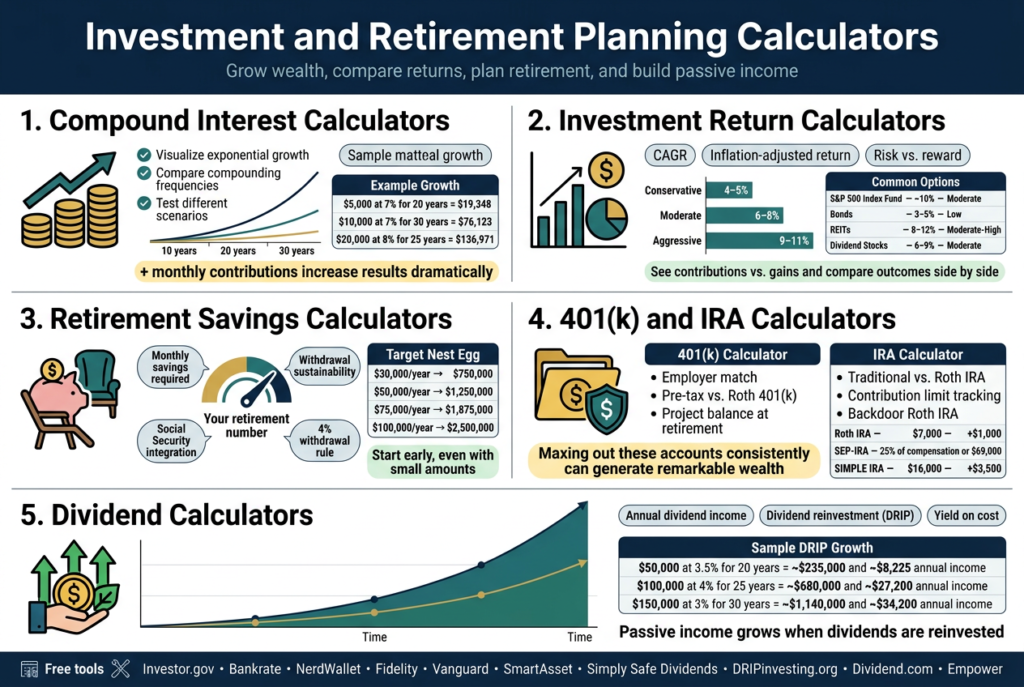
Compound interest is one of the most powerful forces in personal finance — Albert Einstein reportedly called it the eighth wonder of the world, and honestly, he wasn’t wrong. A compound interest calculator helps you see exactly how your money grows when your earnings start earning their own earnings.
Here’s why these calculators are a game-changer:
- Visualize exponential growth: Enter your starting amount, interest rate, and time horizon, and watch how dramatically your money multiplies over 10, 20, or 30 years.
- Compare compounding frequencies: Monthly compounding beats annual compounding — a good calculator shows you exactly how much that difference adds up to.
- Test different scenarios: What happens if you add $200/month to your initial investment? These tools let you experiment without any real-world risk.
Example: How Compounding Works in Practice
| Starting Amount | Annual Rate | Years | Final Value (No Contributions) | Final Value (+$300/month) |
|---|---|---|---|---|
| $5,000 | 7% | 20 | $19,348 | $175,060 |
| $10,000 | 7% | 30 | $76,123 | $378,994 |
| $20,000 | 8% | 25 | $136,971 | $450,892 |
The numbers speak for themselves. Starting early and staying consistent makes an enormous difference — and a compound interest calculator makes that reality concrete rather than abstract.
Popular tools worth checking out include the ones on Investor.gov, Bankrate, and NerdWallet. They’re free, easy to use, and visually show your growth curve over time.
Investment Return Calculators to Compare and Maximize Gains
An investment calculator does more than just crunch numbers — it helps you make smarter decisions by comparing different asset classes, risk levels, and time periods side by side.
Whether you’re choosing between stocks, bonds, ETFs, or real estate, these calculators help you answer the big question: “Where does my money actually work hardest for me?”
Key Features to Look For
- Annualized return (CAGR): This tells you the real year-over-year growth rate, smoothing out the ups and downs.
- Inflation adjustment: A 10% return sounds great until inflation erodes half of it. Good calculators show your “real” return after inflation.
- Risk vs. reward comparison: Some tools let you model conservative (4–5%), moderate (6–8%), and aggressive (9–11%) return scenarios.
- Total contributions vs. gains breakdown: Knowing how much came from your deposits vs. actual market growth is incredibly eye-opening.
Comparing Investment Options
| Investment Type | Average Annual Return | Risk Level | Best For |
|---|---|---|---|
| S&P 500 Index Fund | ~10% (historical) | Moderate | Long-term wealth building |
| Bonds | 3–5% | Low | Capital preservation |
| Real Estate (REITs) | 8–12% | Moderate-High | Passive income + growth |
| High-Yield Savings | 4–5% (current) | Very Low | Emergency fund, short-term goals |
| Dividend Stocks | 6–9% total return | Moderate | Income + appreciation |
A solid investment return calculator takes away the guesswork. You can plug in your current portfolio and quickly see what tweaks — like increasing your equity exposure or adding a small-cap fund — could mean for your financial future 20 years from now.
Retirement Savings Calculators to Secure a Comfortable Future
A retirement planning calculator is one of the most important financial tools you’ll ever use. It connects where you are today with where you need to be — and tells you what you need to do to close the gap.
Most people dramatically underestimate how much they need to retire comfortably. A retirement savings calculator brings that reality into focus quickly.
What These Calculators Help You Figure Out
- Your retirement number: How much total savings you’ll need based on your expected lifestyle and spending.
- Monthly savings required: What you need to put away each month starting now to hit your goal.
- Withdrawal sustainability: Will your nest egg last 20, 25, or 30+ years in retirement?
- Social Security integration: Many calculators let you factor in projected Social Security income to get a more realistic picture.
The 4% Rule and Retirement Calculators
Most retirement calculators are built around the 4% withdrawal rule — the idea that withdrawing 4% of your portfolio annually gives you a very high chance of not running out of money over 30 years. Here’s a quick look at target savings based on desired annual spending:
| Annual Retirement Spending | Target Nest Egg (25x Rule) |
|---|---|
| $30,000/year | $750,000 |
| $50,000/year | $1,250,000 |
| $75,000/year | $1,875,000 |
| $100,000/year | $2,500,000 |
These numbers can feel intimidating, but a good retirement savings calculator shows you that starting early — even with small amounts — makes those targets very reachable. Tools like Fidelity’s Retirement Score, Vanguard’s Retirement Income Calculator, and SmartAsset’s Retirement Calculator are excellent starting points.
401k and IRA Calculators to Optimize Retirement Contributions
Your 401k and IRA are two of the most powerful retirement vehicles available, but most people don’t fully optimize them. That’s where dedicated 401k and IRA calculators come in — they help you squeeze every bit of value out of these tax-advantaged accounts.
401k Calculator Highlights
A good 401k calculator helps you:
- Model the impact of your employer match: If your employer matches 50% of contributions up to 6% of your salary and you’re not contributing at least 6%, you’re leaving free money on the table.
- Pre-tax vs. Roth 401k comparison: Some calculators show you side-by-side projections based on whether you contribute pre-tax (traditional) or post-tax (Roth), factoring in your current and expected future tax brackets.
- Project your balance at retirement: Enter your current balance, annual contribution, expected return, and years until retirement.
IRA Calculator Highlights
- Traditional vs. Roth IRA: This is one of the biggest decisions in retirement planning. A Traditional IRA gives you a tax break now; a Roth IRA gives you tax-free withdrawals later. Calculators that model both based on your income and tax bracket are invaluable.
- Contribution limit tracking: For 2024, the IRA contribution limit is $7,000 ($8,000 if you’re 50+). Calculators help you see what maxing out each year means for your long-term balance.
- Backdoor Roth IRA modeling: If you earn too much to contribute directly to a Roth IRA, some advanced calculators help you plan a backdoor Roth strategy.
2024 Contribution Limits at a Glance
| Account Type | 2024 Limit | Catch-Up (Age 50+) |
|---|---|---|
| 401k | $23,000 | +$7,500 |
| Traditional IRA | $7,000 | +$1,000 |
| Roth IRA | $7,000 | +$1,000 |
| SEP-IRA | 25% of compensation or $69,000 | N/A |
| SIMPLE IRA | $16,000 | +$3,500 |
Maxing out these accounts consistently — especially when paired with smart investment choices — can generate remarkable wealth over a career. Calculators make it easy to see exactly what different contribution levels mean for your retirement outcome.
Dividend Calculators to Estimate Passive Income Potential
Dividend investing is one of the most satisfying wealth-building strategies out there — there’s something genuinely rewarding about getting paid just for owning shares of great companies. A dividend calculator helps you plan and project how much passive income your portfolio can generate.
What a Dividend Calculator Tracks
- Annual dividend income: Based on your number of shares, dividend per share, and payout frequency (monthly, quarterly, or annually).
- Dividend reinvestment (DRIP) growth: When you reinvest dividends instead of spending them, the compounding effect accelerates your wealth significantly. DRIP calculators show this growth over time.
- Yield on cost: As companies raise dividends over time, your yield on your original investment can grow well beyond what the current yield suggests.
- Income projections: How much passive income will your portfolio kick off in 5, 10, or 20 years — especially if you keep adding capital?
Sample Dividend Portfolio Growth with DRIP
| Starting Investment | Dividend Yield | Annual Dividend Growth | Years | Final Portfolio Value | Annual Income |
|---|---|---|---|---|---|
| $50,000 | 3.5% | 6% | 20 | ~$235,000 | ~$8,225 |
| $100,000 | 4% | 5% | 25 | ~$680,000 | ~$27,200 |
| $150,000 | 3% | 7% | 30 | ~$1,140,000 | ~$34,200 |
Assumes dividends are reinvested and dividend growth rate is consistent.
Best Dividend Calculators to Use
- Simply Safe Dividends: Great for tracking dividend safety scores alongside income projections.
- DRIP Returns Calculator on DRIPinvesting.org: Excellent for modeling reinvestment scenarios.
- Dividend.com Calculator: Beginner-friendly with clean visuals.
- Personal Capital (now Empower): Integrates your actual portfolio data for real-time dividend income tracking.
Whether you’re building toward early retirement through dividend income or just want a growing stream of passive cash flow, these calculators take the guesswork out of your strategy and give you a clear, motivating picture of where you’re headed.
Tax and Insurance Calculators Worth Using
Income Tax Calculators to Estimate and Minimize Tax Liability
Taxes catch a lot of people off guard — not because the rules are hidden, but because most of us don’t sit down and do the math until April rolls around. That’s exactly where a solid tax calculator tool becomes your best friend.
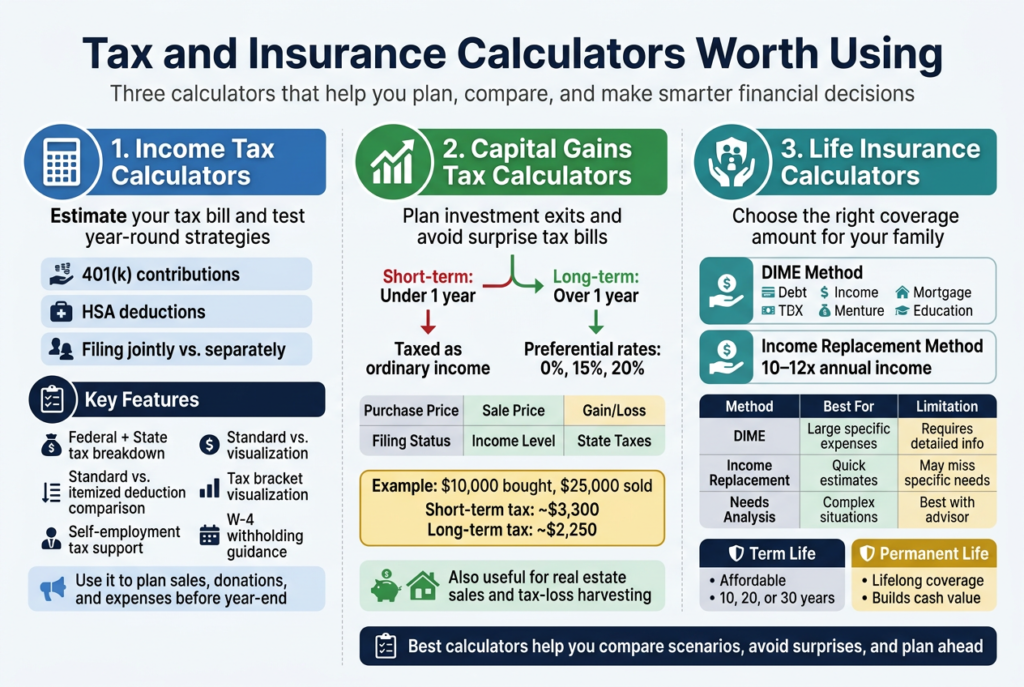
An income tax calculator takes your gross income, applies the relevant deductions, credits, and tax brackets, and gives you a clear estimate of what you owe (or what you might get back). The better ones go beyond the basics and let you experiment with different scenarios:
- What happens if you max out your 401(k) contributions?
- How much does contributing to an HSA reduce your taxable income?
- Would filing jointly or separately save your household more money?
These “what if” experiments are where income tax calculators really shine. Instead of guessing, you get real numbers.
Key Features to Look For
| Feature | Why It Matters |
|---|---|
| Federal + State tax breakdown | Taxes aren’t just federal — state rates vary wildly |
| Deduction comparison (standard vs. itemized) | Helps you pick the option that saves the most |
| Self-employment tax support | Freelancers and business owners have extra obligations |
| Tax bracket visualization | Makes it clear how marginal rates actually work |
| W-4 withholding adjustment guidance | Helps avoid underpayment penalties |
The IRS Tax Withholding Estimator is a reliable free option, and tools like TurboTax’s TaxCaster or H&R Block’s tax estimator do a solid job walking you through deductions in plain English.
The real power of these calculators isn’t just finding out what you owe — it’s using them throughout the year to make smarter financial moves before the tax year closes. Selling stocks, making charitable donations, or timing a business expense can all shift your tax bill significantly if you plan ahead.
Capital Gains Tax Calculators to Plan Investment Exits Wisely
Selling an investment feels exciting — until the tax bill shows up. Capital gains taxes are one of the most commonly misunderstood parts of personal finance, and a capital gains tax calculator helps you avoid nasty surprises.
Here’s the basic breakdown: how long you held the asset determines which rate applies.
- Short-term capital gains (assets held under 1 year) are taxed as ordinary income — which can be brutal at higher income levels.
- Long-term capital gains (assets held over 1 year) qualify for preferential rates: 0%, 15%, or 20% depending on your taxable income.
That difference between short-term and long-term can be thousands of dollars on a single transaction. A capital gains calculator helps you see exactly how much you’d owe under each scenario, so you can decide whether it’s worth waiting a few more months before selling.
What a Good Capital Gains Calculator Should Cover
- Purchase price and sale price — to calculate your actual gain or loss
- Holding period — to determine short vs. long-term treatment
- Your filing status and income level — since capital gains rates depend on where your total income lands
- State capital gains taxes — many states tax these gains as regular income
- Net Investment Income Tax (NIIT) — a 3.8% surtax that kicks in for higher earners
- Tax-loss harvesting opportunities — some calculators let you offset gains with losses from other positions
Practical Example
Say you bought shares of a stock for $10,000 and they’re now worth $25,000 — a $15,000 gain. If you’re in the 22% federal income bracket:
| Holding Period | Rate Applied | Estimated Federal Tax |
|---|---|---|
| Under 1 year (short-term) | 22% ordinary income | ~$3,300 |
| Over 1 year (long-term) | 15% long-term rate | ~$2,250 |
That’s a $1,050 difference just by waiting a bit longer. Multiply that across a portfolio, and smart timing adds up fast.
Tools like SmartAsset’s capital gains tax calculator or the one available on NerdWallet give you a detailed breakdown across both federal and state levels. If you’re working with a financial advisor or investment platform, many of them have built-in gain/loss estimators that tie directly into your account activity.
One thing people often overlook: capital gains calculators are also useful for real estate sales. The IRS allows a $250,000 exclusion ($500,000 for married couples) on the sale of a primary residence — but you need to run the numbers carefully if your gain exceeds those thresholds or if it’s an investment property.
Life Insurance Calculators to Choose the Right Coverage Amount
Life insurance is one of those things people know they probably need but keep putting off because they’re not sure how much to get. Too little and you leave your family exposed. Too much and you’re overpaying for coverage that doesn’t serve a real purpose.
A life insurance calculator cuts through the guesswork by helping you figure out the right coverage amount based on your actual situation — not just a generic rule of thumb.
Common Inputs a Life Insurance Calculator Uses
- Your current income — and how many years your family would need it replaced
- Outstanding debts — mortgage, car loans, student loans, credit cards
- Future expenses — college tuition, childcare costs, eldercare for aging parents
- Existing assets — savings, investments, and any current life insurance policies
- Your spouse’s income — if applicable, to offset some of the coverage need
- End-of-life expenses — funeral costs typically run $8,000–$12,000 or more
Two Main Approaches to Calculating Coverage
1. DIME Method (Debt, Income, Mortgage, Education)
This approach adds up:
- Total debt (excluding the mortgage)
- Income multiplied by the number of years your family needs support
- Mortgage payoff amount
- Education costs for all children
2. Income Replacement Method
A simpler approach that multiplies your annual income by a factor (often 10–12x) to estimate how much your family would need to maintain their lifestyle.
| Method | Best For | Limitation |
|---|---|---|
| DIME | Families with specific large expenses | Requires detailed financial info |
| Income Replacement | Quick estimates | May overlook specific debts or needs |
| Needs Analysis (full) | Complex situations | Best done with a financial advisor |
Term vs. Permanent Insurance — How the Calculator Helps
Most life insurance calculators also help you compare term life vs. whole life or universal life policies. The coverage amount matters, but so does the duration and cost.
- Term life insurance is straightforward and affordable — you pick a coverage amount and a term (10, 20, or 30 years), and the calculator helps match that to your biggest financial obligations.
- Permanent life insurance stays in force for life and builds cash value, but costs significantly more. The calculator helps you weigh whether that extra cost is justified for your goals.
Calculators from providers like Policygenius, Haven Life, or MassMutual walk you through this comparison clearly — and many connect directly to quote engines so you see real pricing alongside the coverage recommendation.
One important note: life insurance calculators give you an excellent starting point, but your actual premium will depend on your age, health history, smoking status, and the insurer’s underwriting standards. Running the numbers first means you walk into that conversation with a clear target rather than relying entirely on what a salesperson recommends.
How to Choose the Best Financial Calculator for Your Needs
Matching the Right Calculator to Your Specific Financial Goal
Picking the right financial calculator starts with getting crystal clear on what you’re actually trying to accomplish. A calculator built for mortgage amortization won’t do you much good if your real problem is figuring out how to pay off your credit card debt faster. Think of it like choosing the right tool from a toolbox — a hammer and a screwdriver are both useful, but only one of them will fix your problem.
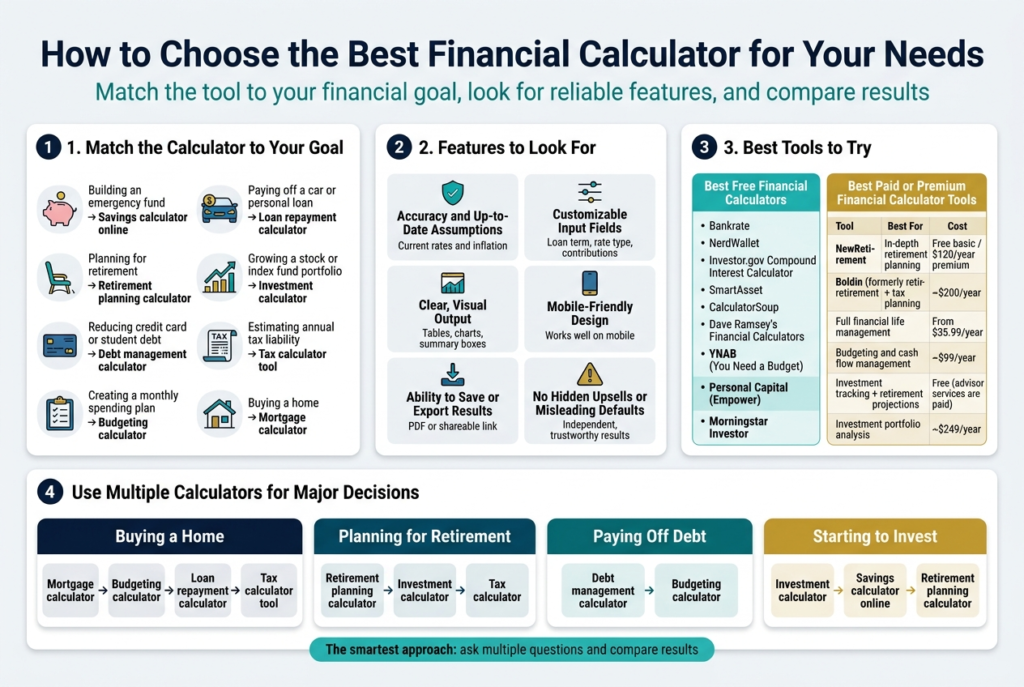
Here’s a quick breakdown of which calculator type fits which goal:
| Your Financial Goal | Calculator to Use |
|---|---|
| Building an emergency fund | Savings calculator online |
| Paying off a car or personal loan | Loan repayment calculator |
| Planning for retirement | Retirement planning calculator |
| Growing a stock or index fund portfolio | Investment calculator |
| Reducing credit card or student debt | Debt management calculator |
| Estimating annual tax liability | Tax calculator tool |
| Creating a monthly spending plan | Budgeting calculator |
| Buying a home | Mortgage calculator |
Before you open any calculator, write down your specific question. Not “I want to save more money,” but something like “How long will it take me to save $10,000 if I put away $400 a month at a 4% annual interest rate?” The more specific your question, the easier it is to find the right tool and actually trust the output it gives you.
Also consider your timeline. Short-term goals (saving for a vacation, paying off a small debt) are well-served by simple, single-purpose calculators. Long-term goals like retirement or building investment wealth benefit from calculators that factor in compounding, inflation, and tax-deferred growth.
Key Features to Look for in a Reliable Financial Calculator
Not every financial calculator on the internet is worth your time. Some are clunky, outdated, or missing the variables that actually matter. When you’re evaluating whether a calculator is worth using, keep an eye out for these features:
Accuracy and Up-to-Date Assumptions
A good calculator should allow you to input current interest rates, tax rates, and inflation figures rather than hardcoding outdated defaults. If a retirement planning calculator assumes a fixed 7% return without letting you adjust it, that’s a red flag.
Customizable Input Fields
The best financial calculators give you control. You should be able to adjust:
- Loan term (months vs. years)
- Interest rate type (fixed vs. variable)
- Contribution frequency (monthly, bi-weekly, annually)
- Inflation rate for long-term projections
- Tax bracket or effective tax rate
- Starting balance or existing debt amount
The more variables you can control, the more accurate and personal your results will be.
Clear, Visual Output
Numbers alone can be hard to interpret. Look for calculators that display results through:
- Amortization tables showing month-by-month breakdowns
- Charts or graphs that visualize growth or payoff timelines
- Summary boxes that highlight the most important figures (total interest paid, projected retirement balance, monthly payment amount)
Mobile-Friendly Design
You’re going to want to run quick calculations on the go. A calculator that only works well on desktop is frustrating when you’re at a dealership or sitting across from a lender.
Ability to Save or Export Results
Some of the best financial calculators let you download a PDF summary or share a link to your specific calculation. This is especially helpful when you’re working with a financial advisor or comparing scenarios over time.
No Hidden Upsells or Misleading Defaults
Some calculator tools are designed to steer you toward a specific product. Watch out for defaults that seem unusually optimistic or inputs pre-loaded with assumptions that benefit a particular company’s product. Always cross-check results on at least one independent platform.
Top Free and Paid Financial Calculator Tools Available Online
There are genuinely excellent free tools available — you don’t have to spend money to get solid financial insights. That said, some paid tools or premium tiers offer features that make a real difference for complex situations.
Best Free Financial Calculators
- Bankrate — Covers everything from mortgage and loan repayment calculators to savings calculators and retirement tools. Clean interface, highly customizable, and trusted by millions.
- NerdWallet — Great for budgeting calculators and debt payoff tools. Their credit card payoff calculator and student loan calculators are particularly well-built.
- Investor.gov Compound Interest Calculator — Run by the U.S. Securities and Exchange Commission, this is one of the most trustworthy investment calculators for long-term growth projections.
- SmartAsset — Excellent for tax calculator tools and retirement planning calculators with location-specific data built in (great for factoring in state taxes).
- CalculatorSoup — A no-frills but highly accurate tool that covers a wide range of financial calculations, from simple interest to detailed amortization schedules.
- Dave Ramsey’s Financial Calculators — Useful for debt snowball planning and basic retirement estimates, though keep in mind the outputs often align with his specific financial philosophy.
Best Paid or Premium Financial Calculator Tools
| Tool | Best For | Cost |
|---|---|---|
| NewRetirement | In-depth retirement planning | Free basic / $120/year premium |
| Boldin (formerly NewRetirement Pro) | Comprehensive retirement + tax planning | ~$200/year |
| Quicken | Full financial life management | From $35.99/year |
| YNAB (You Need a Budget) | Budgeting and cash flow management | ~$99/year |
| Personal Capital (Empower) | Investment tracking + retirement projections | Free (advisor services are paid) |
| Morningstar Investor | Investment portfolio analysis | ~$249/year |
For most everyday financial decisions, the free tools are more than enough. Paid tools tend to shine when your finances get more complex — multiple income sources, investment portfolios, approaching retirement, or running a small business alongside personal finances.
When to Use Multiple Calculators for Better Financial Decisions
Using just one calculator for a major financial decision is a bit like only reading one review before buying a car. It gives you a starting point, but the full picture comes from layering your inputs across different tools.
Here are real situations where running numbers through more than one calculator pays off:
Buying a Home
Start with a mortgage calculator to understand your monthly payment. Then run those same numbers through a budgeting calculator to check if that payment actually fits your cash flow. After that, use a loan repayment calculator to see what happens if you make extra principal payments. Finally, check a tax calculator tool to see how the mortgage interest deduction might affect your annual tax bill.
Planning for Retirement
A retirement planning calculator will project your nest egg based on contributions and assumed returns. But pair that with an investment calculator to stress-test different market return scenarios, and a tax calculator to understand how withdrawals from a 401(k) vs. Roth IRA will be taxed. Each tool answers a different piece of the same puzzle.
Paying Off Debt
Use a debt management calculator to compare the avalanche method (highest interest rate first) vs. the snowball method (smallest balance first). Cross-reference with a budgeting calculator to see how much extra cash you realistically have each month to throw at debt. The two together give you a payoff timeline you can actually stick to.
Starting to Invest
Combine an investment calculator with a savings calculator online to balance how much you’re keeping liquid vs. putting to work in the market. If you’re contributing to a retirement account, layer in a retirement planning calculator to see how your current contributions track against your target retirement age.
The smartest approach to any major financial decision is to ask multiple questions and let different calculators answer each one. When the results across tools point in the same direction, you can move forward with a lot more confidence. When they conflict, that’s your signal to dig deeper or talk to a financial professional before committing.
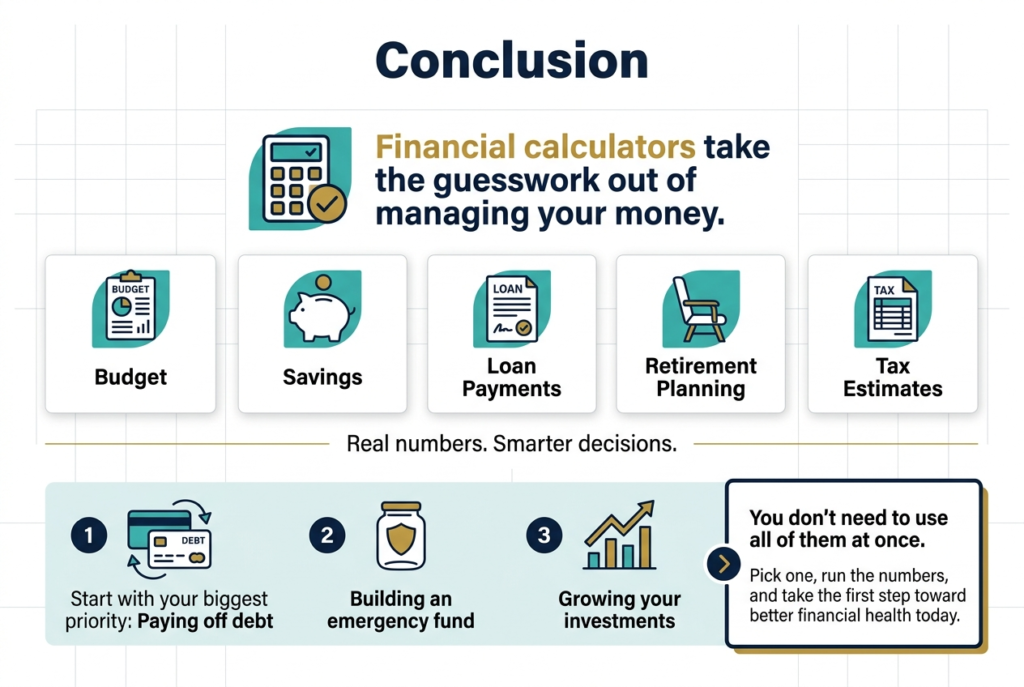
Financial calculators take the guesswork out of managing your money. From tracking your budget and savings to figuring out loan payments, planning for retirement, and estimating taxes, these tools give you real numbers to work with so you can make smarter decisions. Instead of hoping things will work out financially, you get a clear picture of where you stand and what steps to take next.
The best part? You don’t need to use all of them at once. Start with the calculators that match your biggest financial priorities right now, whether that’s paying off debt, building an emergency fund, or growing your investments. The right calculator at the right time can genuinely change how you handle your money, so pick one, run the numbers, and take that first step toward better financial health today.